Highway Series Part 11: The Spaghetti Bowl
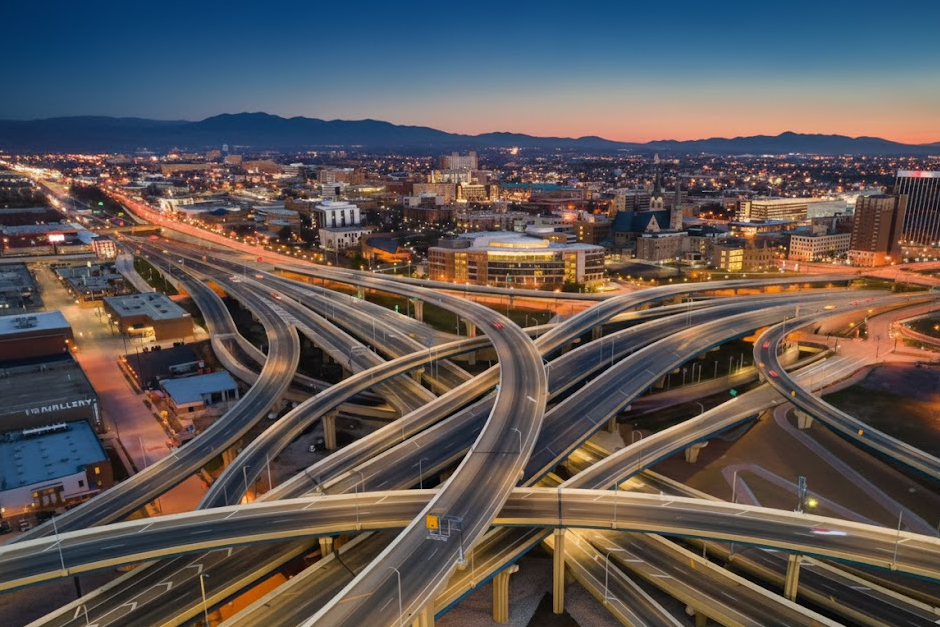
The Spaghetti Bowl is the central freeway junction in Las Vegas. It ties I-15 to I-11. The corridor through and east of the junction also carries US 95 and US 93 as concurrent designations. Martin Luther King Boulevard feeds the interchange from the surface-street grid. NDOT counts about 300,000 vehicles per day across the Project Neon corridor, which runs nearly four miles from Sahara Avenue through the Spaghetti Bowl. That stretch is the busiest piece of highway in Nevada.
For a freight reader, the junction is a control point. When it works, the valley moves as one connected system. When it breaks down, the cost shows up in dock windows, linehaul cutoffs, driver hours, and warehouse flow.
What the Junction Replaced
Before the freeway system, regional movement passed through surface streets. US 91, US 93, and US 95 entered Las Vegas on ordinary roads. Fremont Street, Main Street, and Fifth Street carried the through traffic. Las Vegas Boulevard joined them later. A through truck crossed the valley on city streets, block by block, sharing lanes with downtown traffic, business access, railroad crossings, and turning movements.
The original Spaghetti Bowl opened in 1968. Kiewit built it. The interchange was designed to carry about 60,000 vehicles per day. It connected I-15 to the new Las Vegas Expressway, later renamed the Oran K. Gragson Freeway, which carried US 95 west and northwest of downtown and was extended east toward Henderson between 1982 and 1994. That eastern extension carried I-515 as a concurrent designation for decades.
NDOT rebuilt the interchange between 1997 and 2000 at a cost of $93 million. The rebuild widened the ramps and eliminated the original loop ramps. By 2019, the Project Neon expansion completed a much larger reworking of the I-15 corridor through the junction.
What the Junction Carries
A 2018 Transport Topics report attributed to NDOT counted about 17,900 trucks per day on the I-15 segment through the Spaghetti Bowl and about 2,000 trucks per day on the US 95 segment. Trucks are roughly six percent of total traffic at the junction. The I-15 corridor moves about $95 billion in annual commerce, per the City of Las Vegas infrastructure documentation.
Dale Keller, Project Neon's senior project manager at NDOT, told Transport Topics that the Spaghetti Bowl sees about 25,000 lane changes per hour. That figure is the one freight readers should hold onto. Each lane change is a freight load, a delivery, a shift, or a service call moving toward a customer. The weave count is a measure of regional commerce. The junction does not exist to carry vehicles. It exists to carry the economic activity those vehicles are completing.
The FHWA Freight Analysis Framework identifies the I-15 corridor from I-515 to Tropicana Avenue as a major Las Vegas freight bottleneck, ranked by truck-hours of delay per mile. The Spaghetti Bowl sits inside that segment.
Project Neon
Project Neon was the largest public works project in Nevada history. It cost $1 billion and was substantially completed on May 15, 2019. The project covered nearly four miles of I-15 between Sahara Avenue and the Spaghetti Bowl. NDOT's scope included 63 lane-miles of new paving, 29 new bridges, 10 miles of drainage improvements, more than 20 miles of new HOV network, 42 active traffic management signs, and a new HOV connector between I-15 and US 95 in both directions.
The project also added collector-distributor roads on I-15 south of the junction between Charleston Boulevard and Sahara Avenue. Those roads matter for freight. A collector-distributor road pulls ramp traffic out of the mainline so that entering and exiting traffic can sort itself before joining the through stream. Through trucks stay in their lanes. Local traffic does its merging in a separate roadway. The weaves still happen at the same volume. They have geometry that lets them complete without forcing the whole stream into stop-and-go.
Project Neon did not try to reduce the lane-change count. It gave the lane changes more room. That was the right design decision, because the lane changes are the work the junction is doing.
What Failure Looks Like
On February 4, 2026, a semi carrying 28 cattle rolled on the transition ramp from I-15 south to I-11 south. Sixteen cattle died. The ramp closed during the morning commute. NDOT reopened it at 9:45 a.m., per FOX5 reporting.
That single ramp closure illustrates what the freight reader needs to understand about the junction. The transition from I-15 south to I-11 south is one of the connectors between the two largest corridors in southern Nevada. With it closed, freight bound for Henderson, Boulder City, and Phoenix had to either back-track through downtown surface streets or detour around the valley on the 215 Beltway. The first option burned driver hours. The second option added miles. Both options blew dock windows.
A missed dock window is not a late arrival. It changes the work order inside a facility. A trailer that should have gone to a door waits in the yard. A hostler repositions equipment. Labor assigned to one unload gets reassigned. The driver starts accruing detention time. If the inbound load was feeding an outbound departure later in the shift, the build window compresses. The warehouse defers another shipment, resequences work, or protects the linehaul cutoff at the expense of other commitments.
That is one truck and one ramp closure. The Spaghetti Bowl handles 19,900 trucks per day in normal operations. A morning rush incident on a transition ramp ripples through dispatch boards across the valley. The single visible truck is one signal in a much larger pattern of schedule disruption that spreads outward from the junction.
I-11 and the Corridor's New Name
FHWA approved the I-11 designation for the corridor on November 24, 2023. NDOT began the sign-replacement project in October 2024. The corridor still carries US 95 and US 93 as concurrent designations, and the older I-515 designation has been replaced by I-11 through the valley. Local drivers still use both names. The change matters for freight planners because the I-11 designation positions the corridor as part of a future interstate route between Phoenix and Reno, which will eventually unlock additional federal funding and reshape how the corridor connects to the broader western freight network.
The Spaghetti Bowl sits at the northern end of that I-11 alignment as it currently exists. Future I-11 extensions north of the valley are likely to increase the truck volumes the junction handles. Every freight planner working the Las Vegas valley should expect the Spaghetti Bowl's load to grow.
The Freight Lesson
The Spaghetti Bowl proves that logistics infrastructure can solve one problem and create another. It moved freight off the surface-street pattern and connected the valley's freeway corridors. It also concentrated movement into a central junction where one ramp closure during morning rush can disrupt schedules across the network.
For Southern Nevada logistics, the lesson is plain. The Spaghetti Bowl is a freight control point. When it works, freight moves at 25,000 weaves per hour and supports $95 billion in annual corridor commerce. When it breaks down, dispatchers protect linehaul cutoffs by sacrificing other work, warehouses resequence builds, drivers lose turns, and detention time accrues across the fleet. Project Neon gave the junction better geometry. The junction still concentrates the valley's freight risk into one point on the map.
A dispatcher building a Las Vegas route should know the Spaghetti Bowl's normal travel time, the Beltway detour penalty when the junction breaks, and the dock-window buffer required to absorb the variance. A warehouse operator should plan dock schedules with the junction's performance in mind. A freight broker should understand that Las Vegas appointment risk runs through this single piece of infrastructure. The Spaghetti Bowl is not a traffic landmark. It is a load-bearing element of the regional supply chain.
Sources
The following sources support the historical and operational claims made in this article.
-
Provides the construction history, route designations, 1968 completion date, Kiewit construction credit, original 60,000 vehicles per day design capacity, and the I-11 designation timeline.
-
Spaghetti Bowl work progressing quickly . Las Vegas Sun, September 13, 1999. https://lasvegassun.com/news/1999/sep/13/spaghetti-bowl-work-progressing-quickly/
Source for the $93 million cost of the 1997-2000 reconstruction project and the construction timeline.
-
Southern Nevada's Freight Corridor Gets the Vegas Treatment . Eric Miller, Transport Topics, May 9, 2018. https://www.ttnews.com/articles/southern-nevadas-freight-corridor-gets-vegas-treatment
Source for the 300,000 daily vehicles, 17,900 daily trucks on I-15, 2,000 daily trucks on US 95, the 25,000 lane changes per hour figure attributed to Dale Keller, and the $95 billion in annual I-15 corridor commerce.
-
Project Neon . Nevada Department of Transportation. URL
Source for Project Neon's $1 billion cost, May 15, 2019 substantial completion date, nearly four miles of I-15 covered between Sahara Avenue and the Spaghetti Bowl, 63 lane-miles of paving, 29 new bridges, 10 miles of drainage improvements, 20-plus mile HOV network, 42 active traffic management signs, HOV connectors, and collector-distributor roads.
-
I-11 Designation Announcement . Federal Highway Administration, November 24, 2023. URL
Source for the November 24, 2023 FHWA approval of the I-11 designation through the Las Vegas valley.
-
I-11 Sign Replacement Project . Nevada Department of Transportation, October 2024. URL
Source for the October 2024 start of NDOT's sign-replacement project that signed the corridor as I-11 while retaining US 95 and US 93 concurrent designations.
-
Freight Analysis Framework Bottleneck List . Federal Highway Administration. URL
Source for the identification of the I-15 corridor from I-515 to Tropicana Avenue as a major Las Vegas freight bottleneck ranked by truck-hours of delay per mile.
-
Cattle Hauler Rollover on I-15 to I-11 Transition Ramp . FOX5 Las Vegas, February 4, 2026. URL
Source for the February 4, 2026 semi rollover on the I-15 south to I-11 south transition ramp, the 28 cattle hauled, the 16 cattle that died, and the 9:45 a.m. ramp reopening time.
Leave a Comment
Comments are reviewed before they appear publicly.