Warehousing Series Part 1: The First Place Freight Stopped
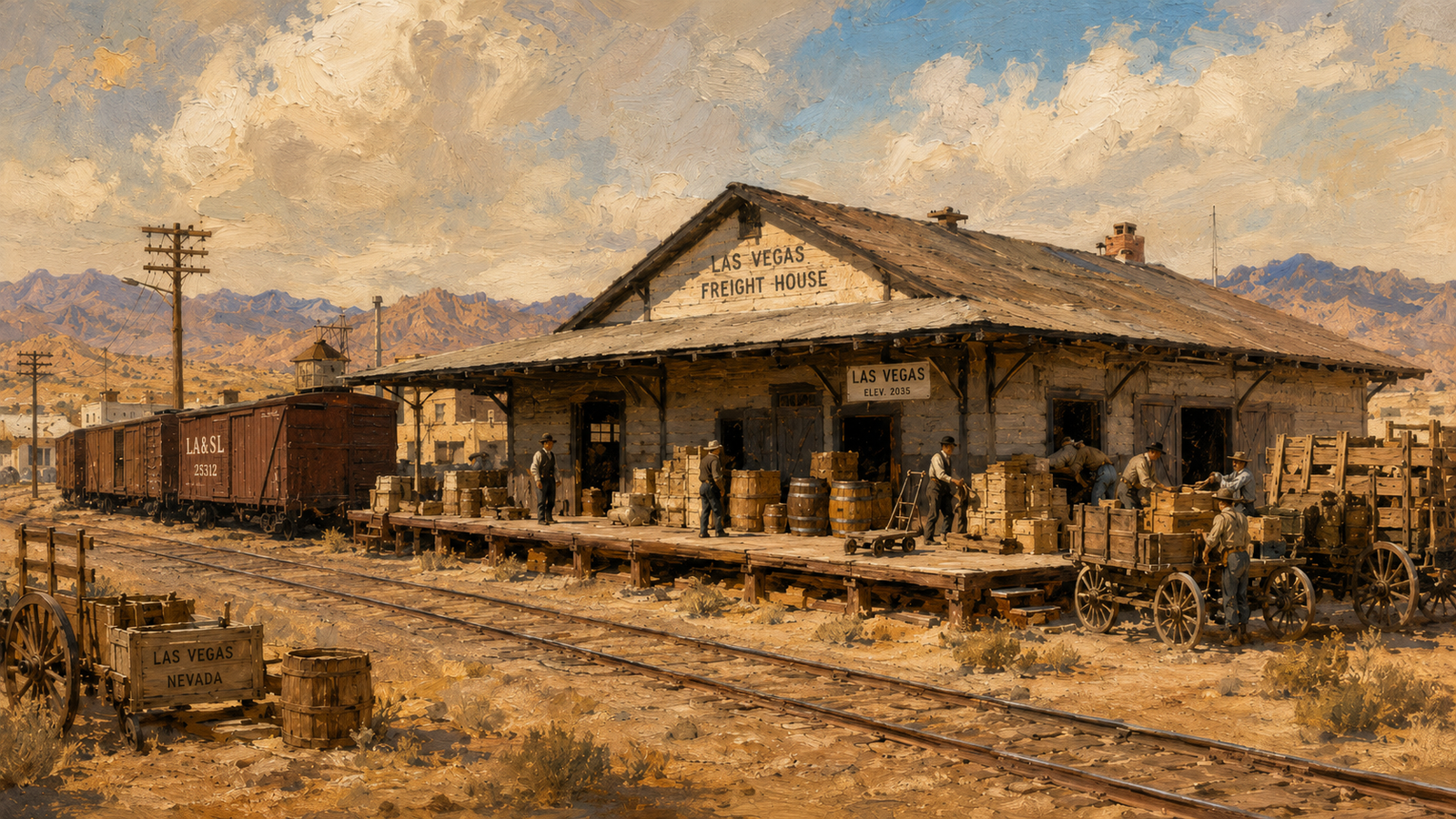
The Las Vegas yard opened in 1905. Before the town had a school, a courthouse, or a paved road, it had the place where freight stopped.
The San Pedro, Los Angeles and Salt Lake Railroad built Las Vegas as a division point. Locomotives needed water and fuel. Trains took on fresh crews. The operational logic was about the corridor, not the town. Las Vegas existed to keep trains moving between Salt Lake City and Los Angeles. Everything else followed from that.
What a Freight House Was
A warehouse holds goods. A freight house moves them. Railcars spotted along the house track had their doors aligned with a loading platform built to match the car floor. Workers moved freight directly from the car to the platform using hand trucks.
Inside, a single boxcar might hold shipments for a dozen different consignees. Clerks sorted the cargo, matched crates and barrels to the paperwork, and staged each shipment for pickup. Wagons backed up to the street side of the building and collected the goods. Later, trucks did the same job.
Freight paused in the building for hours, sometimes a day. Then it left. It was the handoff point between the long-distance corridor and the local economy.
Where It Sat
The Las Vegas yard stood at the north end of Main Street, anchored at Main and Fremont. The depot faced south toward the new townsite. The freight house operated in the yard alongside it.
The railroad platted the town. The Las Vegas Land and Water Company, a railroad subsidiary formed in 1905, controlled the townsite and its lots. The townsite auction happened on May 15, 1905. Buyers bought proximity to the yard.
The commercial district grew south from the depot along Fremont Street because freight moved that direction. That corner of Main and Fremont is still the center of the old city.
What It Handled
Southern Nevada already needed freight in 1905. Mining camps at Rhyolite, Goldfield, and Tonopah needed supplies. Ranching operations worked the surrounding land. New construction began as soon as the first lots sold. The freight house served all of it.
Hardware, building materials, machinery parts, packaged food, clothing, and equipment arrived by rail from distant markets. Las Vegas had no manufacturing base of its own in 1905. Commercial supplies came through the corridor, and mixed shipments entered the local distribution system through the freight house.
Full carloads went to the team tracks alongside the freight house. Merchants, contractors, and mining operations brought wagons to the siding, opened the car doors, and removed the cargo themselves. Lumber for new buildings and equipment for the mines both moved through the team tracks. The Las Vegas and Tonopah Railroad, which ran northwest from the yard starting in 1906, carried supplies out to the mining camps.
The First Logistics Problem
The freight house solved a specific problem: how to get goods off a long-distance corridor and into an economy that had no other way to receive them. Las Vegas had no road connections to the outside world in 1905 that could carry commercial freight volume. Wagon roads carried light loads at short range. The geography created a single point of entry, and everything passed through it.
The freight house had no redundancy. A blocked corridor, a delayed train, a shortage of cars, or an error in sorting would stop goods from reaching their destinations.
What It Established
The freight house set the terms for how the valley would receive freight for the next several decades. The location of the yard fixed the point where freight entered the local economy. The town grew toward it and around it. As the city expanded, the distances from the yard to the edges of the settled area grew. That expanding radius created the pressure that eventually produced the next layer of staging infrastructure -- not because anyone planned it, but because the distances made it necessary.
Trucks and highways broke the single-yard model. New staging facilities appeared wherever road access and land availability intersected, on land the railroad didn't own and serving routes the railroad didn't run. The freight house's successors scattered across the valley. The railroad was powerless to control freight that didn't arrive by rail.
The Building Is Gone
The original freight facilities at the Las Vegas yard are gone. The Union Pacific depot was replaced in 1940 and demolished in 1969 to make way for the Union Plaza hotel. The yard itself shrank as land values rose and casino development pushed north from Fremont Street. What had been a working railroad yard at the center of a freight town is now the north end of the Fremont Street Experience.
The function the freight house served did not disappear with the building. The valley still needs places where freight enters the local economy, stops briefly, sorts, and continues outward. Those places are larger now, faster, and spread across hundreds of millions of square feet of industrial space in North Las Vegas, Henderson, and along the I-15 corridor. None of it belongs to the railroad.
The freight house was the first attempt at the problem. Everything that followed was built without it.
Sources
The following sources support the historical and operational claims made in this article.
-
Union Pacific Railroad Collection . UNLV Special Collections / ArchiveGrid. https://researchworks.oclc.org/archivegrid/collection/data/714657752
Documents the railroad's purchase of the Stewart ranch, the construction of early railroad buildings in Las Vegas, and the formation of the Las Vegas Land and Water Company in 1905. The collection includes architectural drawings of freight houses in the Las Vegas yard dating from 1908. Supports the claims about the railroad's control of the townsite and the staging infrastructure around it.
-
Guide to the Union Pacific Railroad Collection . UNLV Libraries Special Collections. https://www.library.unlv.edu/speccol/finding-aids/MS-00397.pdf
Confirms that tracks reached the Las Vegas site from Utah in October 1904 and from California in January 1905, that Las Vegas was established as a division point, and that the townsite lots were auctioned on May 15, 1905. Supports the timeline of the yard's opening.
-
Vintage Railroad Depots Offer Glimpses of Nevada's Past . Las Vegas Review-Journal. https://www.reviewjournal.com/entertainment/entertainment-columns/trip-of-the-week/vintage-railroad-depots-offer-glimpses-of-nevadas-past/
Confirms the location of the original Las Vegas depot at Main Street at the end of Fremont Street, its replacement in 1940, and its demolition in 1969 for the Union Plaza hotel. Supports the description of the yard's location and its eventual disappearance from the downtown landscape.
-
Freight House . Wikipedia. https://en.wikipedia.org/wiki/Freight_house
Describes the function of railroad freight houses, including the design of the house track, the loading platform, the sorting of less-than-carload shipments, and the role of clerks in matching cargo to consignees. Supports the operational description of how the freight house moved goods between the rail corridor and local transport.
-
Las Vegas and Tonopah Railroad . Wikipedia. https://en.wikipedia.org/wiki/Las_Vegas_and_Tonopah_Railroad
Documents the Las Vegas and Tonopah Railroad's connection to the main yard and its route northwest toward the mining districts at Goldfield and Tonopah, beginning in 1906. Supports the claim that the yard served as the staging point for supply movements into the mining economy of southern Nevada.
Leave a Comment
Comments are reviewed before they appear publicly.