Highway Series Part 10: Nellis and the Corridor
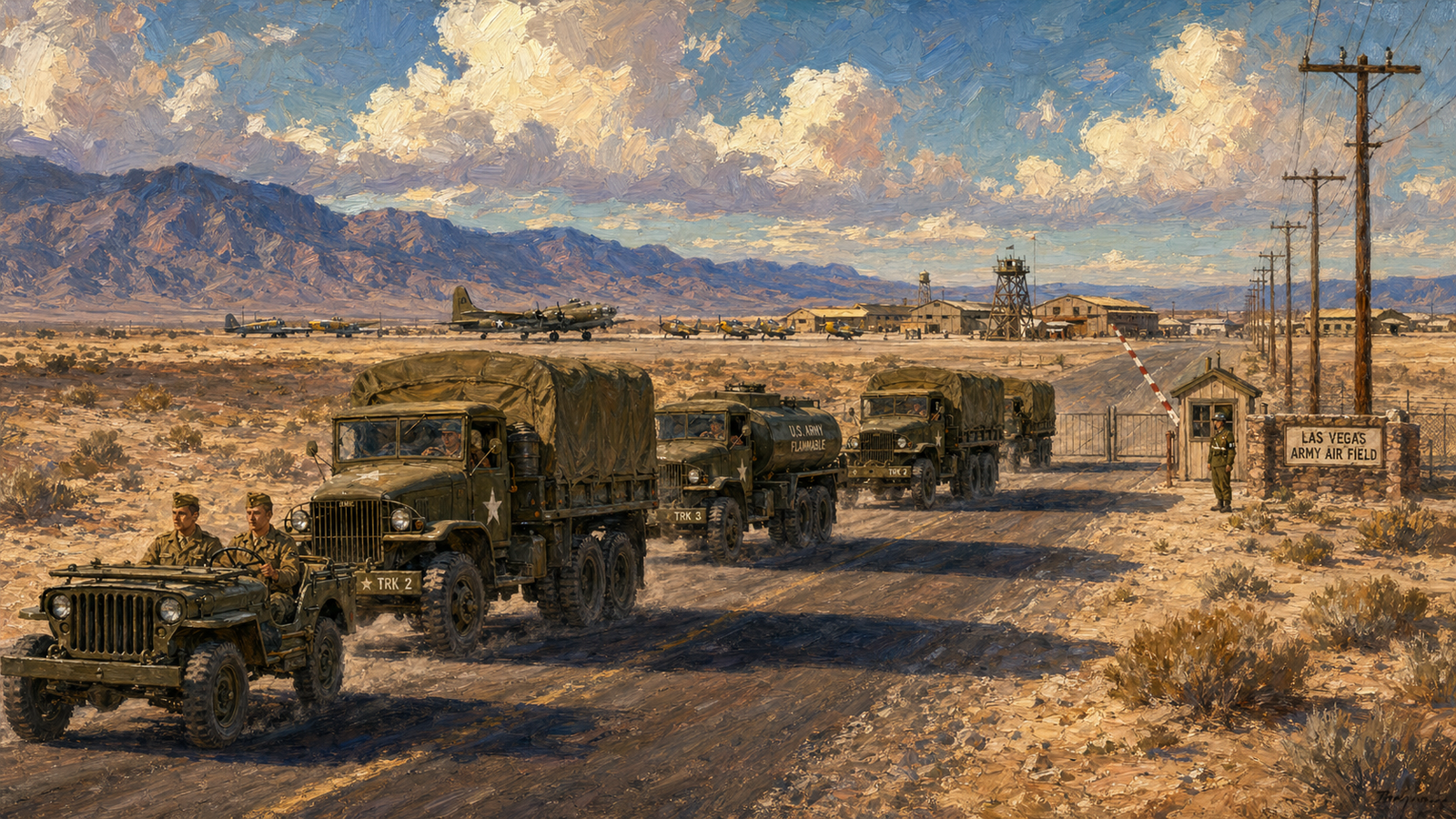
By 1941 Las Vegas was already a logistics node. The railroad had made the town a division point in 1905. US 91 was the freight corridor between Los Angeles and Salt Lake City. Boulder Highway carried freight southeast to Boulder City and Hoover Dam. The valley moved people, fuel, construction materials, and equipment through desert terrain on schedule.
The Army Air Corps needed a gunnery school in the desert Southwest. The infrastructure that made Las Vegas a freight hub made it a military candidate. The base that became Nellis Air Force Base was built on ground the corridor had already prepared.
The Airstrip Before the Base
Nellis sits eight miles northeast of Las Vegas along US 91. The ground started as a dirt airstrip. W.A. Simon built it in 1929. It sat beside the highway that carried freight and passengers between Los Angeles and Salt Lake City. The route brought fuel, supplies, and travelers. The airstrip needed all three.
Western Air Express bought the field in 1932. It became a scheduled stop on the Los Angeles to Salt Lake City mail and passenger route. The line the railroad had established decades earlier now carried aircraft on the same axis. The freight logic was identical. Movement between the two cities required a stop in the Las Vegas Valley.
Why the Army Chose the Site
The Army Air Corps searched for a gunnery training site in 1940. Nevada offered open airspace, flat terrain, clear weather, and distance from populated areas. Those criteria pointed the search toward the desert Southwest.
The Las Vegas airstrip offered fuel, road access, rail support, water, and a labor pool eight miles down the highway. Those criteria narrowed the search to one location. The aviation requirements explained why Nevada. The logistics requirements explained why Las Vegas.
The Ten-Dollar Transfer
The City of Las Vegas bought the field on January 2, 1941, for ten dollars. Three days later it leased the property to the Army. The installation became Las Vegas Army Air Field. Military-side construction began that March. Crews used available Works Progress Administration barracks, Civilian Conservation Corps equipment, and Civilian Conservation Corps fuel as the small airfield was converted into a military installation. The base later expanded onto federal land outside the original city parcel. The modern Nellis sits in unincorporated Clark County.
Ten dollars made the transfer official. The corridor did the rest. A working highway, a service town, and federal labor on hand turned a small airfield into a military installation in months.
Supplying a Military Installation
Las Vegas Army Air Field ran on a military cadence. Aviation fuel arrived daily. Munitions arrived under separate security on dedicated rail cars. Construction materials arrived in waves as new buildings went up. Food, uniforms, vehicles, spare parts, and communications equipment arrived continuously. Personnel rotated through on schedules tied to training cycles.
Rail handled the heavy and the bulk. Tank cars of fuel. Boxcars of materials. Flatcars of equipment. US 91 handled the trucks, the workers, and the shorter-haul supplies from local vendors. Las Vegas itself supplied the labor pool, the lodging for civilian workers, and the off-base services.
By 1944 the field trained gunners and pilots in volume. Thousands of trainees rotated through annually. Each cycle required fuel for training flights, ammunition for gunnery practice, and replacement parts for aircraft that flew hard and broke often. The freight load scaled with the training tempo.
The route that had built the railroad town now fed a federal installation. The same roadbed carried civilian freight and military supply. The system scaled because the road was already built.
Materiel
Materiel is the military word for everything an armed force moves except personnel. Weapons. Vehicles. Equipment. Spare parts. Fuel. Ammunition. Field rations. Communications gear.
Civilian freight serves customers. Materiel serves missions. The difference shows up at the loading dock. A civilian shipper optimizes for cost through just-in-time delivery and lean inventory. Market demand sets the pace. A delayed shipment costs money.
Military materiel runs on readiness. The customer is the operational unit. A delayed shipment grounds an aircraft. Doctrine builds in redundancy. Forward stocks. Multiple supply routes. Standardized parts across the force. The cost of failure shows up on a flight line.
A driver running US 91 to the field gate handled both kinds of cargo in the same week. The truck stayed the same. The cargo changed. Paperwork changed. Security tightened. Delivery windows narrowed.
Both kinds of freight used the same route. Fuel trucks shared the highway. Boxcars shared the rails. The road itself was indifferent. Priority logic decided who got through first when capacity tightened. Las Vegas became a freight town that served both systems at once.
The Field Changes the Valley
The corridor helped build the field. Then the field helped build the corridor.
The base created steady demand for roads, housing, fuel, utilities, and labor movement northeast of Las Vegas. Workers needed a way to get to the gate. Officers needed housing. Suppliers needed road access. The valley extended infrastructure to meet a new scale of demand.
Sunrise Manor and North Las Vegas grew on the back of base employment. Civilian contractors needed offices. Servicemembers needed housing. Suppliers needed warehouses near the gate. The valley's northeast quadrant filled with the support economy of a federal installation.
Northeast Las Vegas became a permanent edge of the city. The roads that fed the base became civilian arterials. Land along those roads filled in with housing and services. The military presence anchored a section of the valley the highway had previously passed through.
From Las Vegas Army Air Field to Nellis Air Force Base
The Air Force was established as a separate service in 1947. In 1950 Las Vegas Army Air Field was renamed Nellis Air Force Base. The name honored Lieutenant William Harrell Nellis, a P-47 pilot from Searchlight, Nevada, killed in action over Luxembourg in December 1944.
The local connection mattered. Nellis was a Nevadan. Searchlight sat sixty miles south of Las Vegas on US 95, the corridor that carried freight between Las Vegas and the lower Colorado. The naming acknowledged a man the southern Nevada highway network had carried in both directions, first to training and then home.
A Military Node in the Highway Network
Nellis functioned as a node. It concentrated movement. It required supply. It demanded access. It tied local roads to national defense priorities.
Wartime traffic on US 91 reflected that. Convoy movements got priority. Fuel allocations shifted. One corridor served both, and the military had first call. After the war that priority eased. The integration remained.
The Cold War expanded the load. Nellis acquired the bombing and gunnery range that became the Nevada Test and Training Range. Atomic testing at the Nevada Proving Grounds added a second federal customer for the same regional freight system. The route carried both.
Nellis became a permanent freight customer. It still is. Daily deliveries enter through the gate. Simon's airstrip joined the highway in 1929. The same corridor now carries the supply chain of a major Air Force installation.
The Corridor Pattern Repeats
Las Vegas grows where movement has already been solved. The railroad made the first node in 1905. US 91 extended the system. Hoover Dam and Henderson proved that industry followed the corridor. Nellis showed that military infrastructure followed it too.
The pattern holds. Wherever the valley solves movement, new forms of activity appear. The corridor came first. Everything else followed.
Sources
The following sources support the historical and operational claims made in this article.
-
Continuing Evolution: 75 Years of Nellis History . Nellis Air Force Base, United States Air Force. https://www.nellis.af.mil/News/Article/664716/continuing-evolution-75-years-of-nellis-history/
Establishes the timeline from W.A. Simon's 1929 airstrip through the 1932 Western Air Express purchase, the 1941 Army lease, and the 1950 rename. Used to anchor all dates in the post.
-
Nellis Air Force Base . Nellis Air Force Base, United States Air Force. https://www.nellis.af.mil/About/Fact-Sheets/Display/Article/284174/nellis-air-force-base/
Provides the modern installation footprint and confirms the location eight miles northeast of Las Vegas. Supports the geographic and operational descriptions of the present-day base.
-
Documents the postwar expansion, the acquisition of the bombing and gunnery range that became the Nevada Test and Training Range, and the relationship between Nellis and the Nevada Proving Grounds. Supports the Cold War expansion paragraph.
-
Confirms Lieutenant Nellis's birthplace in Searchlight, Nevada, his service as a P-47 pilot, and his death in action over Luxembourg in December 1944. Supports the biographical paragraph on the base namesake.
Leave a Comment
Comments are reviewed before they appear publicly.