Rail Series Part 6: Freight Houses and Team Tracks
Where Rail Met the Local Economy
The railroad corridor carried freight across long distances, but most goods did not begin or end their journey on the mainline. Somewhere along the route, freight had to leave the train and enter the local economy. That transfer did not happen in the open desert between towns. It happened at specific facilities built for that purpose.
At railroad yards across the West, those facilities were freight houses and team tracks. They formed the point where long-distance rail transport met the shorter movements that supplied towns, mines, ranches, and construction projects beyond the reach of the rails.
Las Vegas had been engineered as a division point in the Los Angeles–Salt Lake corridor. Locomotives took on water and fuel there, crews exchanged, and trains continued along the line. But around that same yard another kind of work took place. Freight cars arriving from distant markets were opened, unloaded, sorted, and sent outward again.
The railroad moved goods between regions. Freight houses and team tracks moved those goods into the surrounding economy. At places like Las Vegas, the corridor did not simply pass through the desert. It connected to the ground beneath it.
The Freight House
The freight house was the railroad’s primary facility for handling merchandise freight. While bulk commodities such as ore, livestock, or lumber often moved in full carloads, many shipments were smaller. Hardware, clothing, machinery parts, food products, and building materials often traveled in quantities too small to fill an entire railcar. Those shipments were handled through the freight house.
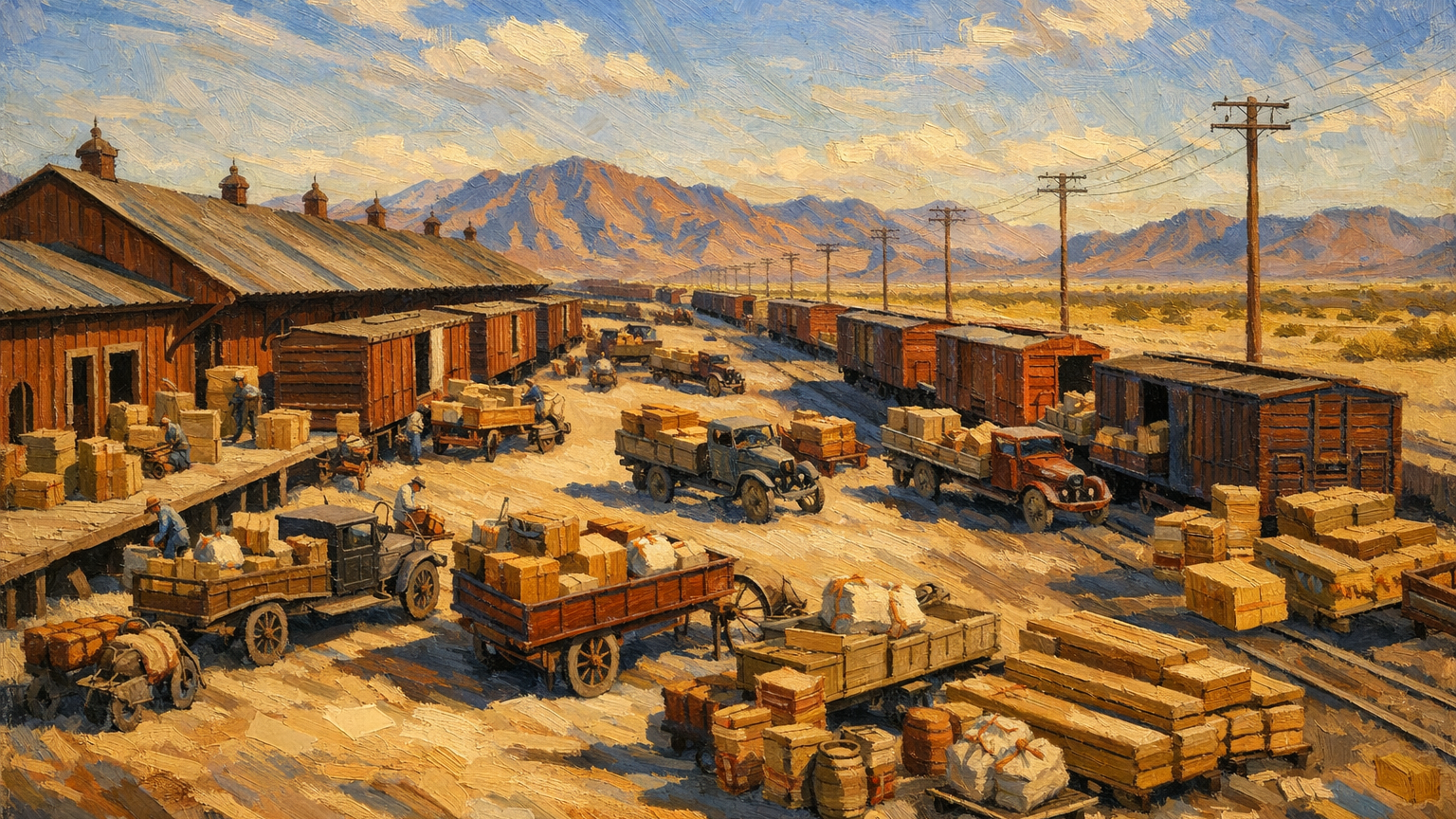
The building itself was designed for efficient transfer between railcars and local transport. Freight houses were typically long, rectangular structures built beside a siding known as the house track. Railcars carrying merchandise freight were spotted along this track so their doors aligned with the loading platform.
The platform was built at approximately the same height as the floor of a freight car. Large sliding doors opened along the rail side of the building, allowing workers to move freight directly between the car and the platform using hand trucks and carts. This design eliminated the need to lift cargo from ground level and allowed freight to move quickly through the building.
Inside the freight house, shipments were unloaded and sorted. A single boxcar might contain goods destined for many different merchants. Crates, barrels, and boxes were separated according to their consignees and staged for pickup. Clerks recorded the arrival of each shipment and prepared the paperwork required for delivery.
The opposite side of the freight house faced the street. Wagons and drays backed up to this side of the building to collect freight for delivery around town. Later, motor trucks performed the same function. In this way the freight house served as the transfer point between the long-distance rail network and local delivery.
At division points such as Las Vegas, the freight house handled a steady flow of merchandise arriving from distant markets. Goods unloaded there did not remain in the yard for long. They moved outward into stores, construction projects, ranches, and mining camps across the surrounding region. The building was not a warehouse for long-term storage. It was a place where freight paused briefly before continuing its journey by local transport.
Team Tracks
Not every shipment passing through the railroad required the services of a freight house. Many customers received freight in full carload quantities. For those shipments the railroad provided a simpler facility known as the team track.
A team track was a siding where railcars could be placed so customers could unload them directly. The name came from the horse teams that once pulled wagons to the cars. Merchants, ranchers, contractors, and mining companies brought their wagons to the track, opened the car doors, and removed the cargo themselves.
Unlike the freight house, the team track required little permanent structure. In many towns it consisted of a graded area beside a siding with enough space for wagons to maneuver and load. Freight cars were spotted along the track, and local teams worked alongside them until the cargo was removed.
Team tracks were commonly used for shipments that filled an entire car. Lumber for construction, machinery for mines, feed for livestock, and other bulky materials often arrived this way. Because the consignee handled the unloading, the railroad did not need to move the freight through a building or sort it inside a depot.
This arrangement made the team track a practical solution for towns that lacked large warehouses or industrial spurs. Any merchant or contractor who needed a carload shipment could receive it there. Once the car arrived, wagons hauled the goods away in smaller loads for use around town or in the surrounding countryside.
At division points such as Las Vegas, team tracks allowed the railroad to deliver carload freight quickly into the local economy. Railcars arrived from distant regions, were set out on the siding, and were unloaded directly by the people who needed the goods. In this way the team track extended the reach of the rail corridor beyond the yard and into the working life of the town.
Las Vegas Operations
Around the Las Vegas yard, the work of the freight house and the team tracks connected the railroad corridor to the town and the surrounding desert. Trains passing through the division point carried freight across long distances, but some of those cars were set out for local delivery. Once they reached the yard, the goods entered the local distribution system that served the valley and the regions beyond it.
Merchandise shipments moved through the freight house where they were unloaded, sorted, and collected by local merchants. Hardware, building materials, machinery parts, clothing, and packaged food arrived from distant markets and were transferred to wagons for delivery into town. Stores, construction projects, and service businesses all depended on this steady flow of rail freight.
Carload shipments were handled at the team tracks. Lumber for new buildings, mining equipment, feed for livestock, and other heavy freight arrived in full railcars and were unloaded directly by the customers who ordered them. Wagons hauled these materials away in smaller loads to mines, ranches, and construction sites across the region.
In this way the Las Vegas yard served two roles at once. It was a division point where locomotives were serviced and trains continued along the corridor. It was also the place where freight moving across the West entered the local economy of southern Nevada. Through the freight house and the team tracks, goods arriving by rail spread outward across the valley and into the working landscape of the desert.
The Arrival of Trucks
Early in the twentieth century, another kind of vehicle began appearing at the same sidings. Instead of wagon teams waiting beside the railcars, motor trucks began pulling up to the unloading platforms. At first the numbers were small. Most freight still left the yard behind horses or mules.
But the advantage of the truck was obvious. It could travel farther in a day and carry heavier loads without the care and feeding that animal teams required. As roads improved across southern Nevada, trucks gradually replaced the wagon teams that had once dominated the team tracks.
The function of the facility did not change. Railroads still carried freight across long distances. The yard still served as the point where those carload shipments entered the local economy. What changed was the vehicle that carried the freight away from the siding.
By the 1920s and 1930s, trucks had become a regular sight around the Las Vegas yard. What had once been a line of wagons waiting beside the rails slowly became a line of motor trucks ready to carry freight out into the growing desert town.
The Shape of a Modern Logistics System
The infrastructure built for wagon teams did not disappear when new forms of transport arrived. The same sidings, loading platforms, and open working yards that once served horse-drawn wagons were easily adapted to motor trucks. The vehicle changed, but the physical arrangement of the yard continued to function.
Rail remained the backbone of long-distance freight movement. Trains carried goods across the wide distances of the American West, linking distant markets and industrial regions. Around the yards, however, other forms of transport connected to that system. Freight houses and team tracks allowed goods arriving by rail to move outward by whatever vehicles served the local economy.
As road networks expanded and trucks became more common, those vehicles increasingly handled the short-distance work that wagons had once performed. The railroad yard continued to operate as the point where freight transferred between systems.
Long before the language of intermodal logistics existed, places like the Las Vegas freight yard were already performing the same basic function. Rail carried freight across regions. Local transport carried it the final miles. The yard stood between them, turning a corridor of movement into a working distribution network as new forms of transportation continued to grow around it.
The railroad corridor remained the backbone of long-distance freight across the desert. But the vehicles leaving the yard were beginning to travel farther each year as roads improved and trucks replaced wagon teams. The next series follows that outward movement, tracing how highways expanded the freight network that began at the rail yard.
Sources
The following sources support the historical and operational claims made in this article.
-
Freight House . Wikipedia / Railroad historical references. https://en.wikipedia.org/wiki/Freight_house
Explains the function of railroad freight houses as facilities used to receive, unload, sort, and temporarily store less-than-carload freight before delivery by wagon or truck. This supports the article’s description of how merchandise freight moved through freight houses before entering local distribution systems. :contentReference[oaicite:0]{index=0}
-
What Is a Team Track? . Trains Magazine / Kalmbach Media. https://www.trains.com/mrr/beginners/ask-trains/what-is-a-team-track/
Describes team tracks as railroad sidings where customers without private rail spurs could unload freight cars using wagons or trucks. The explanation of horse teams giving the facility its name supports the article’s discussion of how early freight moved from railcars into local transport systems. :contentReference[oaicite:1]{index=1}
-
Railway Sidings and Team Tracks . Wikipedia / railway engineering references. https://en.wikipedia.org/wiki/Siding_(rail)#Team_track
Provides a technical definition of team tracks as public sidings used by merchants, farmers, and businesses to load and unload freight directly from railcars. This supports the article’s description of how carload freight was delivered into local economies through shared railroad facilities. :contentReference[oaicite:2]{index=2}
-
Traffic Sources – Freight Houses and Team Tracks . SmallMR Historical Railroad Operations. https://smallmr.com/wordpress/traffic-sources-freight-houses-and-team-tracks/
Discusses how freight houses served as community shipping centers and how team tracks allowed large shipments to be unloaded directly by customers. This supports the article’s explanation of how railroad facilities connected long-distance freight movement to local economic activity. :contentReference[oaicite:3]{index=3}
Leave a Comment
Comments are reviewed before they appear publicly.