Rail Series Part 5: Freight Through the Corridor
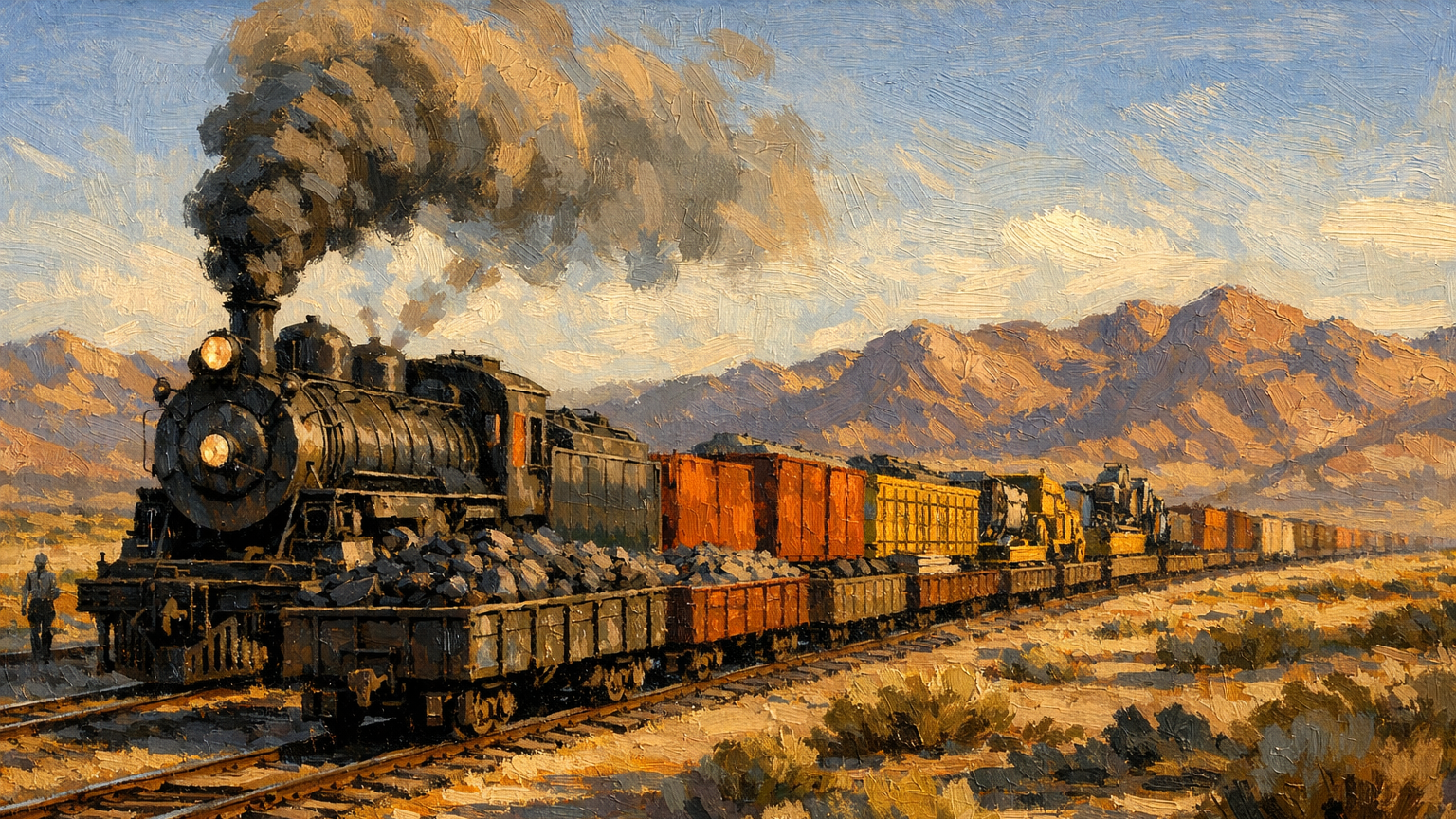
The line between Los Angeles and Salt Lake City was not built primarily to serve the towns along it. It was built to move freight between regions. Las Vegas functioned as a servicing interval inside that movement. Trains stopped at the division point to take water and fuel, exchange crews, inspect equipment, and reorganize freight before continuing north or south. The division point did not exist because Las Vegas needed freight. Las Vegas existed because the corridor required a place to handle it.
Two Directions of Freight
Trains passing through the Las Vegas yard often began their journey hundreds of miles away and were bound for markets just as distant. The corridor connected two very different regional economies. Southern California was an industrial and commercial center supplying manufactured goods and building materials. The interior West produced mineral resources, livestock, and agricultural products that moved toward coastal markets.
Northbound trains coming out of California carried manufactured goods, machinery, lumber, and food supplies bound for interior settlements and mining districts. Southbound trains arriving from the interior West carried ore concentrates, livestock, and agricultural products moving toward markets and processing facilities connected to the rail networks of Southern California.
Mining Freight
Mining districts in central Nevada generated some of the most important freight moving through the corridor during the early twentieth century. Camps such as Tonopah and Goldfield depended on a steady flow of supplies arriving from outside the region. Mines required heavy machinery for hoists and pumps, steel rails for underground haulage, timber for shaft supports, explosives for blasting, and large quantities of fuel and food for workers living in remote camps. Much of this material moved north from California through the Las Vegas yard.
Freight bound for the mining districts arrived in several forms. Boxcars carried equipment, tools, and packaged supplies. Flatcars transported heavy machinery and structural materials. Carloads of timber were shipped for underground supports. These cars were assembled into freight trains that continued north through the corridor toward Nevada’s mining regions.
The traffic did not move in only one direction. After extraction and preliminary processing, ore concentrates were loaded into gondolas and ore cars at mining sidings. These heavy carloads moved south toward rail junctions where they entered the main corridor. From there the trains continued through Las Vegas toward smelters and industrial facilities connected to the California rail network.
The scale of this traffic reflected the mining boom that swept central Nevada in the early twentieth century. Investors and operators such as George Wingfield helped finance and consolidate many of the mines and milling operations in the Tonopah and Goldfield districts. Their enterprises required steady transportation for equipment, supplies, and processed ore. Railroads provided that connection, linking remote desert camps to smelters, markets, and financial centers hundreds of miles away.
The connection between the mining districts and the main line was strengthened by the Las Vegas and Tonopah Railroad. That line linked the mining camps of central Nevada with the Los Angeles–Salt Lake corridor. Supplies moved north toward the mines. Ore moved south toward processing centers. Through this interchange the Las Vegas division point handled freight tied directly to the mining economy of central Nevada.
Agricultural and Livestock Traffic
Mining was not the only industry using the corridor. Ranching and agricultural regions across the interior West also relied on the rail line moving through Las Vegas.
Cattle and other livestock were regularly loaded onto stock cars in ranching districts across Nevada and neighboring states. Ranchers drove animals to rail loading pens where they were counted, inspected, and placed into railcars designed for animal transport. Once assembled into trains, these shipments moved south through the corridor toward rail connections serving the large population centers of Southern California.
Livestock traffic required careful handling. Animals had to be watered and rested at intervals during long journeys. Railroads maintained stock pens and watering facilities at designated stops along the line. From these points the trains continued toward markets, slaughterhouses, and distribution centers serving the coastal cities.
Agricultural products followed the same corridor. Grain, hay, and other farm goods moved in boxcars and gondolas from interior farming districts. Produce shipments traveled alongside mining traffic and general merchandise freight moving through the system.
The result was a corridor serving several industries at once. Mining districts required supplies and shipped ore. Ranching regions shipped livestock. Agricultural areas moved food products toward growing coastal markets. All of that traffic passed through the same rail system.
Merchandise Freight
Not all rail traffic moving through the corridor consisted of bulk commodities such as ore or livestock. A large share of the freight handled by the railroads was ordinary merchandise bound for towns across the desert.
Merchandise freight moved primarily in boxcars. These cars carried the everyday goods that sustained settlements throughout the region. Hardware, building materials, clothing, household items, packaged food, and other manufactured products arrived by rail mixed into regular freight trains passing through Las Vegas.
Much of this freight originated in the factories, warehouses, and wholesale markets of Southern California. Railroads assembled these shipments into carloads destined for towns and mining camps across Nevada and the interior West.
When merchandise cars were set out at Las Vegas, the cargo was transferred to the local freight house. Inside these buildings shipments were sorted, recorded, and staged for delivery. Crates, barrels, and boxed goods were organized by merchant and destination.
Merchants collected their shipments directly from the freight house, or teamsters hauled the cargo by wagon to stores, construction sites, and businesses around town. In this way the railroad functioned not only as a long-distance corridor but also as the supply line for communities scattered across the desert.
The Local Layer of the Corridor
The freight moving through the corridor did not simply pass Las Vegas without stopping. Some railcars were set out at the division point and entered the local economy of the valley.
These cars were unloaded at freight houses or at team tracks where merchants and ranchers could collect their shipments. A team track was a public siding where wagons could pull alongside railcars to load or unload freight directly. Hardware, food, equipment, and building materials arriving from distant regions were transferred from railcars to wagons and, later, to trucks for delivery around Las Vegas and the surrounding countryside.
Freight houses handled smaller shipments that required sorting and storage. Inside these buildings rail shipments were recorded, separated by destination, and staged for pickup. Crates, barrels, and boxed goods were assembled for merchants serving the growing town and nearby ranching districts.
In this way the long-distance corridor also supported a local distribution system. Freight that had traveled hundreds of miles by rail completed its journey in the final miles by wagon or truck.
The mechanics of that transfer—freight houses, team tracks, and local hauling—formed an essential part of how railroads served desert communities.
Movement Before Identity
In these years Las Vegas was not yet a destination city. It was an interval in a freight corridor linking the Pacific coast with the interior West.
The trains passing through the yard carried the supplies, machinery, livestock, agricultural products, and ore that connected those regions. Las Vegas handled that movement because the corridor required a place where trains could be serviced, crews exchanged, and freight transferred.
The mechanics of that exchange—freight houses, team tracks, and local hauling—formed the next layer of the system at the division point.
Sources
The following sources document the physical geography of the Las Vegas Springs, the railroad’s acquisition of the Stewart Ranch, and the early corporate administration of land, water, and rail infrastructure in the Las Vegas townsite.
-
Springs Preserve — History of Las Vegas Springs . Springs Preserve, Las Vegas, Nevada.
Overview of the Las Vegas Springs, early settlement history, and the transfer of the Stewart Ranch property to the San Pedro, Los Angeles & Salt Lake Railroad.
-
Las Vegas Land and Water Company Records . UNLV Special Collections and Archives, University of Nevada, Las Vegas.
Archival records documenting the railroad subsidiary responsible for land sales, water distribution, and townsite administration in early Las Vegas.
-
Nevada State Historic Preservation Office — Las Vegas Railroad Depot Documentation . Nevada State Historic Preservation Office.
Historical documentation describing the Las Vegas depot as the operational center of early rail activity and commercial clustering in the townsite.
-
Evans, K. J. — “J. T. McWilliams” . Las Vegas Review-Journal.
Biographical profile of surveyor J. T. McWilliams and his attempt to establish the competing “McWilliams Original Townsite of Las Vegas.”
-
History of the San Pedro, Los Angeles & Salt Lake Railroad . UtahRails.net.
Historical overview of the Salt Lake Route and its division points linking Los Angeles with Salt Lake City.
Leave a Comment
Comments are reviewed before they appear publicly.