Rail Series Part 4: The System Under Stress
The Corridor Continues to Run
The railroad corridor did not stop running when the First World War ended. Trains continued to move between Los Angeles and Salt Lake City. Telegraph dispatchers still governed the line. Division points still handled the same sequence of work—locomotives serviced, crews exchanged, freight cars sorted, departures released on schedule.
But the conditions surrounding that routine had changed. Traffic had surged during the war and did not simply return to earlier patterns. Corporate authority had shifted to a larger national system. Labor expectations had been altered by federal wage policy and its abrupt reversal. New regulatory structures were beginning to shape railroad operations as well.
None of these changes removed the rails or the yards. The corridor itself remained intact. What changed was the margin inside which it operated. Tasks that had once been performed with comfortable intervals were now performed with tighter timing and less flexibility.
Part 4 begins there. The railroad system that had created stability across the desert was still running, but it was now carrying more weight and operating under greater strain.
Through-Traffic Expands Across the West
The Los Angeles–Salt Lake line was not built primarily to serve the towns along it. It was built to move freight between regions. Cars that rolled through Las Vegas often began their trip hundreds of miles away and were bound for markets just as distant.
Agricultural shipments from the interior West moved toward Pacific ports and coastal cities. Mining districts sent ore and refined metals eastward. Manufactured goods from industrial centers moved west to supply growing populations in California and the desert Southwest. As the population of the Pacific coast expanded, inbound freight to those markets increased as well.
Las Vegas sat in the middle of that movement. The yard handled trains that were passing through rather than terminating there. Freight cars were inspected, locomotives were serviced, and crews were exchanged before the trains continued along the corridor.
As traffic across the West expanded during the early twentieth century, the volume of freight moving through the line increased with it. The corridor continued to function as designed, but each additional train reduced the margin that had once existed between arrivals, servicing, and departures.
Longer Trains and Heavier Loads
Railroads did not respond to rising traffic by immediately building new lines. The first response was to move more freight over the track that already existed.
That meant longer trains and heavier loads. Additional cars were added to consists. Locomotives were pushed closer to their hauling limits. Dispatchers tightened the spacing between meets on single-track segments of the corridor. Equipment that once spent longer periods in yards or roundhouses was returned to service more quickly.
Each change increased the amount of freight the railroad could move in a given day. But each change also reduced the margin that had once existed inside the schedule.
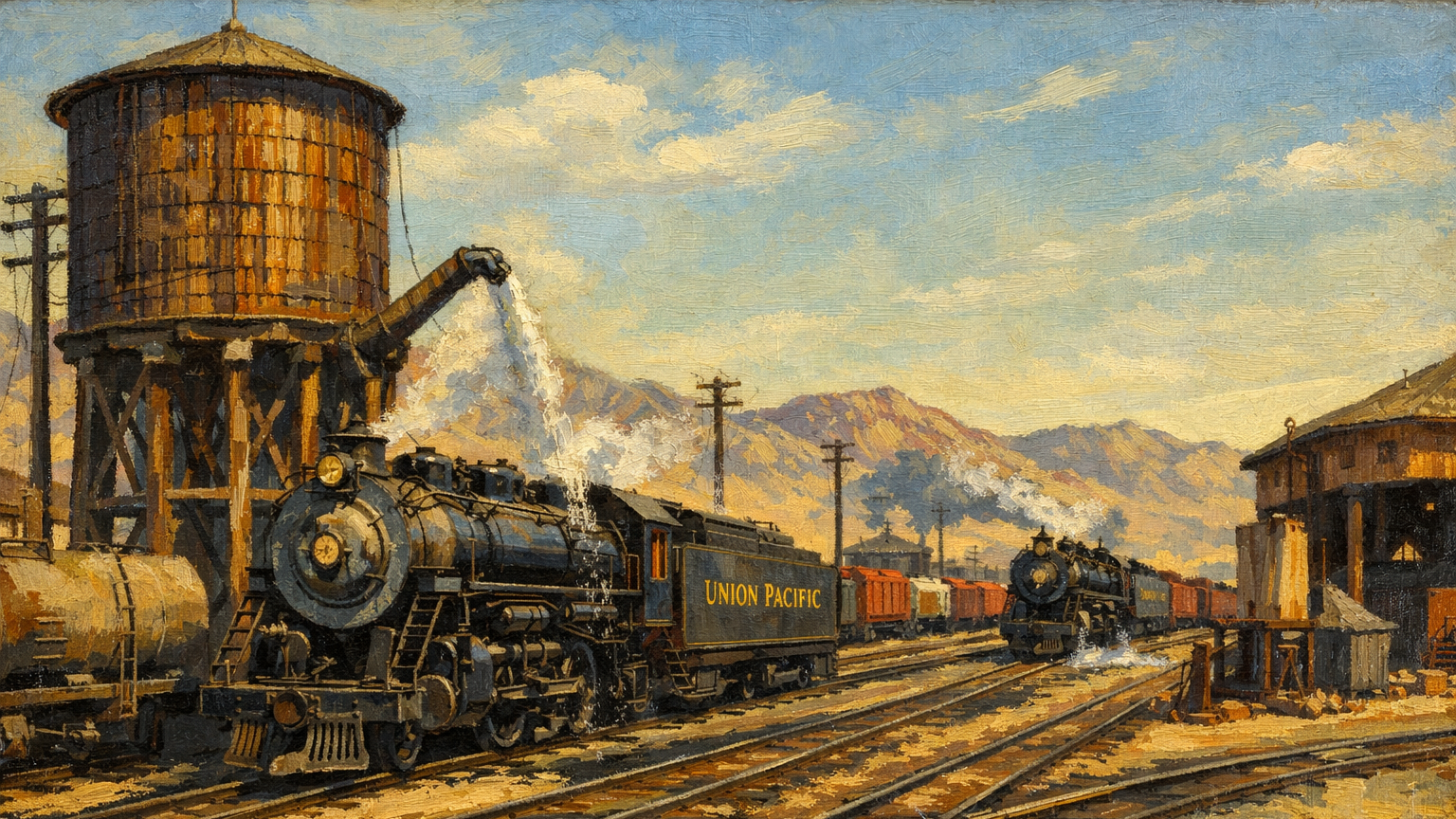
At division points like Las Vegas, the effect was practical and immediate. Locomotives arrived needing water, fuel, and inspection, but the time available for those tasks was shorter than it had been a decade earlier. Yard crews classified freight cars under tighter departure windows. The sequence of work remained the same. The interval still functioned. But the pace inside it had increased.
Fixed Infrastructure and Limited Flexibility
The railroad corridor had been engineered around physical limits. Division points were not placed arbitrarily along the line. They were positioned according to the operating range of steam locomotives, the capacity of water and fuel facilities, the legal and practical limits on crew working hours, and the yard space required to sort and stage freight cars.
Those factors created the intervals that governed the movement of trains across the desert. As long as traffic remained within the range the system had been designed to handle, the corridor functioned with predictable rhythm.
When freight volume increased, those same design choices imposed limits. Water tanks could supply only so many locomotives in a given period. Roundhouses and service tracks could handle only a certain number of engines at once. Yard tracks could classify only so many cars before space ran tight.
Infrastructure could be expanded, but expansion required capital, engineering work, and coordination across the broader network. Those changes did not happen overnight.
As a result, the first signs of strain rarely appeared as failure of the line itself. They appeared as congestion—locomotives waiting for service, freight cars sitting longer in classification tracks, and schedules tightening as dispatchers worked to keep traffic moving along the corridor.
Union Pacific Integration
When the Salt Lake Route was absorbed into the Union Pacific system in 1921, the corridor running through Las Vegas did not physically change. The same yard tracks remained in place. The same locomotives arrived for water, fuel, and inspection. Crews still signed in and out against the same desert run.
What changed was where the operating decisions were made.
Before the merger, the line had been managed largely as its own corridor. Dispatching, maintenance priorities, and capital improvements were evaluated within the needs of that route itself. After the merger, the line became one segment inside a larger Union Pacific network.
Traffic moving through Las Vegas now competed with traffic across the wider system. Locomotives and rolling stock were assigned according to network priorities. Yard improvements, additional service tracks, or expanded facilities required approval within a national capital program rather than a regional budget.
For the Las Vegas division point, the daily work looked the same. Trains arrived. Engines were serviced. Crews changed. But the decisions shaping how much traffic moved through the corridor and how much capacity the yard received were now made far beyond the desert where the trains passed.
Labor as a System Dependency
Railroad operation depended on more than track and locomotives. It depended on skilled labor that kept the equipment moving.
Shopmen maintained steam locomotives, repaired freight cars, and inspected the machinery that allowed trains to return to the line. At division points like Las Vegas, that work was part of the operating rhythm. Locomotives arrived, were serviced and inspected, and then returned to the corridor for the next run.
When that maintenance cycle slowed, the effects moved quickly through the system. Locomotives remained in service tracks longer than planned. Freight cars accumulated in yards waiting for repair or inspection. Departure windows slipped as equipment failed to return to the line on schedule.
The shopmen’s strike of 1922 exposed that dependency. The railroad corridor could still move trains, but the machinery that sustained that movement required continuous attention. When the workforce responsible for that work withdrew, the strain appeared not as a single dramatic failure but as a series of delays that spread outward through the network.
Regulation and Operating Constraints
Railroads in the early twentieth century did not operate entirely on their own terms. Federal regulation had been expanding for decades, and by the 1920s it formed a permanent part of the operating environment.
The Interstate Commerce Commission oversaw freight rates and commercial practices. Federal safety rules governed equipment standards and operating procedures. Labor conditions had also entered the national regulatory framework, particularly after wartime wage boards and subsequent federal involvement in labor disputes. Crew work hours were increasingly defined by formal rules rather than local practice.
None of these measures stopped trains from moving. In many cases they improved safety and stabilized relations between railroads, workers, and the public. But they also reduced the freedom railroads once had to adjust operations quickly when problems appeared.
The result was a more structured operating environment. The corridor still functioned, but dispatchers, managers, and crews worked inside a growing set of formal constraints that limited how much the system could improvise when traffic surged or disruptions occurred.
Las Vegas as a Pressure Point in the Corridor
Under heavier traffic and tighter margins, pressure in the corridor often appeared first at the division points. Las Vegas was one of those intervals where the system had to pause long enough to service locomotives, exchange crews, and prepare trains for the next segment of the line.
As traffic increased, that pause became harder to maintain. Locomotives arriving from the desert runs sometimes waited their turn for water, fuel, or inspection. Freight cars accumulated in classification tracks as yard crews worked through the arriving consists. Departure windows narrowed as dispatchers tried to keep trains moving through the corridor without disrupting the sequence of meets along the single-track segments.
The yard still performed the same work it had always performed. Engines were serviced. Crews were changed. Trains departed in both directions along the line. But the tasks that had once been carried out with comfortable spacing were now performed with less margin for delay.
Las Vegas remained what it had been designed to be: an operational interval in the corridor. What changed was the pressure placed on that interval as the system around it carried more traffic and operated under tighter conditions.
The Limits of a Single System
The railroad corridor across the desert had been engineered for a specific purpose: moving long-distance freight between regions. For decades it performed that task with remarkable efficiency. Trains moved on schedule, division points maintained the rhythm of the line, and the network tied distant markets together.
By the early twentieth century the system remained dominant, but the pressures inside it were becoming easier to see. Traffic volumes continued to rise. Labor disruptions exposed how dependent the system was on specialized maintenance work. Corporate consolidation shifted decision-making farther from the line itself. Regulation introduced rules that shaped how the railroads could operate.
None of these forces stopped the trains. The corridor continued to function much as it always had. But the margin that had once made the system feel self-contained was narrowing.
As freight volumes continued to grow across the American West, railroads would remain essential. At the same time, the limits of a single transportation system were becoming clearer. New forms of freight movement would begin to develop alongside the rail network, adding flexibility where the corridor alone could not easily provide it.
Sources
The following sources document wartime traffic expansion, federal control, postwar regulation, labor strain, and the growing pressure on the Las Vegas division point within the western rail corridor.
-
San Pedro, Los Angeles and Salt Lake Railroad . Online Nevada Encyclopedia.
Background on the corridor's construction, regional freight function, and the line's integration into the Union Pacific system in 1921.
-
Union Pacific Railroad Collection . UNLV Special Collections and Archives, University of Nevada, Las Vegas.
Corporate records documenting Las Vegas yard operations, division point administration, and the transition from Salt Lake Route management to Union Pacific system control.
-
United States Railroad Administration Annual Reports, 1918–1920 . U.S. Government Printing Office.
Federal management of the railroads during World War I, wartime traffic patterns, and the operating conditions that preceded the return to private management.
-
Interstate Commerce Commission Annual Reports, 1917–1922 . Interstate Commerce Commission.
Regulatory framework governing freight rates, equipment standards, and operating procedures in the postwar period.
-
Railway Shopmen's Strike of 1922 . U.S. Department of Labor historical summaries; Wikipedia overview.
Background on the 1922 strike, its origins in postwar wage disputes, and its effects on maintenance operations at division points across the national network.
-
Federal Hours of Service Act (1907) . U.S. Federal regulatory documentation.
Federal regulation governing crew working hours, referenced in the discussion of operating constraints at division points.
-
Orsi, Richard J. Sunset Limited: The Southern Pacific Railroad and the Development of the American West, 1850–1930. University of California Press, 2005.
General reference on western railroad operations, freight corridor development, and the competitive and regulatory environment facing western lines in the early twentieth century.
-
Athearn, Robert G. Union Pacific Country. Rand McNally, 1971.
Standard reference on Union Pacific's expansion across the West, corporate consolidation strategy, and the integration of regional lines into the national system.
-
Las Vegas Age (1917–1922) . Nevada Newspaper Archives, Library of Congress.
Contemporary reporting on wartime and postwar rail traffic, labor conditions, and local economic effects at the Las Vegas division point.
Leave a Comment
Comments are reviewed before they appear publicly.