Rail Series Part 3: Stability Through Design
The Division Point in Operation
In 1911, Las Vegas incorporated as a city. Incorporation did not determine whether the town would endure. That question had already been answered by the construction of the line. Once the Los Angeles–Salt Lake line was complete and trains ran on a fixed schedule in both directions, Las Vegas was no longer a speculative company town. It was a division point inside a regional freight system.
That position was not incidental. Division points were engineered into the corridor at measured intervals to supply water, fuel, inspection, crew exchange, and freight handling. Las Vegas occupied one of those intervals because the line required it. The corridor could not operate efficiently without it.
Each day, northbound and southbound trains entered the yard under telegraph coordination. Arrival times were known. Departure windows were fixed. The narrow margin between them imposed order. Every task in the yard followed sequence.
Locomotives were cut from their consists and moved to the service track. Boilers were inspected, fireboxes cleaned, and water taken on from the tank fed by the Las Vegas springs. Coal was staged in measured quantities against the next segment's fuel requirements. Mechanical issues identified in transit were assessed — minor repairs completed on site, serious defects flagged for the shop. A locomotive that entered the yard was expected to leave it fit for the next run.
While power was being serviced, freight cars were worked. The yard crew pulled inbound cars, read their waybills and sorted them into northbound and southbound consists. Cars bound for Salt Lake moved north. Cars bound for Los Angeles moved south. Cars requiring local delivery were set out on the house track. Merchandise freight for Las Vegas merchants was unloaded at the depot platform. Outbound agricultural products and livestock from surrounding ranch operations were loaded and documented.
The Las Vegas and Tonopah connection added a distinct freight stream. By 1907, the Las Vegas & Tonopah Railroad was moving ore south for connection to the Salt Lake Route at Las Vegas, where cars were transferred and forwarded south toward smelters in the Los Angeles basin and onto Southern Pacific lines serving California’s industrial and port facilities. Silver and gold ore concentrates moved south toward the reduction mills and smelters accessible via Los Angeles connections. Mining supplies — timber, machinery, explosive materials, consumer goods for camp populations — moved in the opposite direction, transferred from SP main line cars to LV&T equipment for the run north. The interchange required paperwork, physical transfer in some cases, and coordination between two operating railroads sharing the same yard space.
Crew changes ran on their own schedule alongside all of this. Engineers and firemen arriving from Caliente or from the Mojave segment signed off their runs, logged their hours, and turned over their locomotives. Fresh crews signed on, reviewed orders, and took their trains. The bunkhouse adjacent to the yard existed because rest requirements were not optional — Federal Hours of Service law, enacted in 1907, limited how long crews could remain on duty before mandatory rest. The depot was not only a mechanical interval. It was a labor interval as well.
Railroad Labor and Craft Organization
Las Vegas was therefore not only a mechanical node in the corridor. It was a labor node as well. The railroad workforce operating out of the division point was part of a national labor structure that had developed alongside the railroad industry itself. Railroad work was divided into crafts. Engineers operated locomotives. Firemen managed the boilers and fuel. Conductors supervised trains and documentation. Trainmen handled switching and car movement. In the shops, machinists, boilermakers, blacksmiths, electricians, sheet metal workers, and carmen maintained the machinery that kept the line moving. Each of those trades had its own organization.
By the time the Los Angeles–Salt Lake line reached southern Nevada in 1905, most of those crafts were represented nationally through unions known in the industry as the railroad brotherhoods and shop craft unions. Engineers belonged to the Brotherhood of Locomotive Engineers. Firemen joined the Brotherhood of Locomotive Firemen and Enginemen. Conductors were represented by the Order of Railway Conductors. Trainmen organized through the Brotherhood of Railroad Trainmen. Shop workers joined their own craft organizations, including the International Association of Machinists, the International Brotherhood of Boilermakers, the International Brotherhood of Blacksmiths, the Brotherhood of Railway Carmen, the International Brotherhood of Electrical Workers, and the Sheet Metal Workers’ International Alliance.
These organizations had developed during the late nineteenth century as railroads spread across the country. The Brotherhood of Locomotive Engineers dated to 1863. The Brotherhood of Locomotive Firemen followed in 1873. Others formed as specialized railroad trades multiplied. The structure reflected the way railroads actually functioned. A locomotive engineer did not perform the work of a machinist, and a machinist did not perform the work of a conductor. Each craft guarded its skills, and each organized separately.
As Las Vegas grew into its role as a division point, local workers joined that national framework. Crews arriving and departing through the yard were not isolated employees in a remote desert town. They were members of the same craft organizations that represented railroad workers across the American rail network. The same occupational structure that governed a locomotive shop in Nebraska or Illinois governed the shops and crews working out of Las Vegas.
In the early years this structure existed alongside the operational discipline of the railroad itself. The company set schedules. Dispatchers issued orders. Crews ran trains and shopmen kept the equipment serviceable. The system depended on cooperation between management authority and skilled labor operating within clearly defined roles. For more than a decade, that balance held with little disruption.
Operational Discipline of the System
Telegraph traffic ran continuously through all of it. Dispatchers coordinated movements, issued track warrants, reported delays, and adjusted meets between opposing trains. A train held at a siding north of Las Vegas because of a mechanical issue generated a cascade of adjustments — departure times shifted, crew rest calculations changed, freight connections at the next division point were affected. The telegraph tied the Las Vegas yard to every other division point on the line. When one train was late, the shift rippled across the system.
The system worked as long as traffic moved and authority remained clear. The railroad set the schedule. The crews followed it. The yard executed it. For more than a decade, that arrangement held. It depended on mines producing, markets buying, and trains moving on schedule. In the early years, all three were working.
The Las Vegas Land and Water Company handled the ground side of the operation. Organized in 1905, it managed land sales, leases, and water distribution while the railroad ran the line. The springs came with the Stewart Ranch purchase in 1902, acquired for fifty-five thousand dollars. The water secured the interval. It tied the yard to the town, and the town to the railroad.
Water meant settlement. Settlement meant payroll. Payroll meant commerce. The company controlled industrial blocks, commercial frontage, and residential lots. It was the largest landowner in town, the largest employer, and the largest business. Land use aligned with rail operations.
The yard fed the town in practical terms. Merchants restocked from freight cars. Ranchers shipped cattle and produce on the line. Ore moved through on feeder connections. Crews coming off duty spent wages locally before signing on again. What looked like a frontier town finding its footing was a railroad interval performing as designed.
It held because Tonopah and Goldfield were still shipping ore south in steady volume, and because those cars moved through Las Vegas on schedule. The arrangement was efficient. It was clear. And it relied on conditions that would not remain fixed.
Incorporation changed the letterhead, not the timetable. City hall could pass ordinances, but it did not dispatch trains. The division point still ran on intervals engineered into the Los Angeles–Salt Lake corridor: water, fuel, inspection, crew limits, and the daily work of sorting cars into northbound and southbound order. Las Vegas’s durability in these years came from that design. The yard was not a local project that happened to survive. It was a required interval in a corridor that needed one.
Wartime Intervention and System Strain
During the First World War, the federal government took control of the railroads under the United States Railroad Administration, operating them from 1917 to 1920. Wages were standardized and, in many cases, raised to maintain uninterrupted wartime traffic. The system was run as a coordinated national network rather than as separate private lines.
The war did more than change who signed paychecks. It changed what moved and how often it moved. Freight cars carrying steel, fuel, and munitions materials were given priority. Troop trains altered the passenger schedule. Locomotives logged longer runs between overhauls, and rolling stock cycled through division points with less maintenance time. At Las Vegas, consists lengthened and meets tightened. The buffer between arrival and departure windows narrowed. The interval remained intact, but the margin inside it grew thinner.
When federal control ended in 1920, the railroads returned to private management. Costs had risen. Traffic patterns had shifted. Management moved to reduce wages that had been elevated under federal authority. The workforce did not accept the reversal quietly.
By 1921, the Salt Lake Route had been formally absorbed into the Union Pacific system. Policy for lines running through Las Vegas was no longer set by a semi-independent regional company but by a centralized corporate structure operating at national scale.
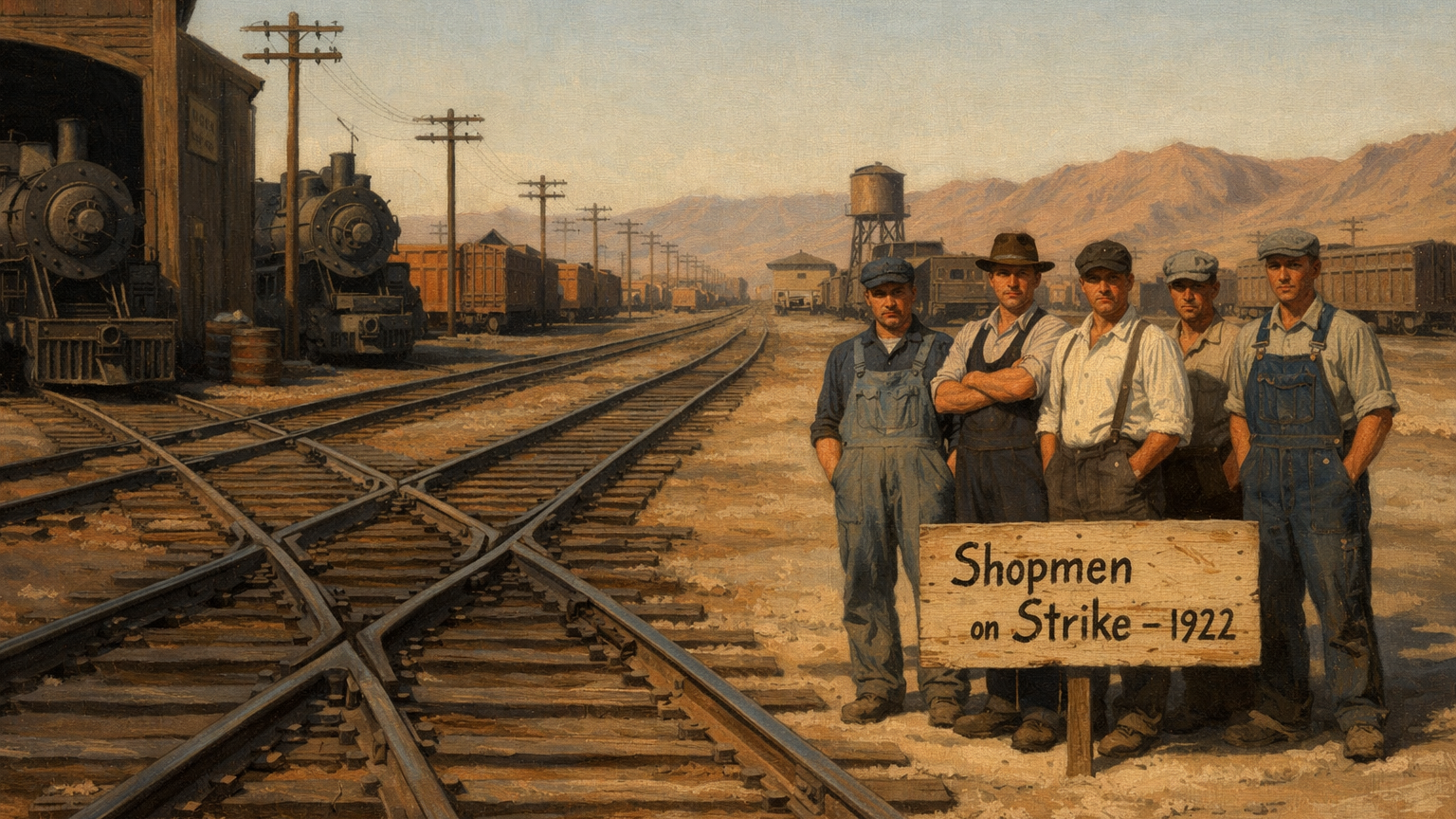
The shopmen’s strike of 1922 grew out of that transition. Workers who had operated under a wartime wage structure were being asked to return to lower terms under private control. The authority that had set expectations was gone. The railroads inherited a labor force that had experienced a different baseline.
For Las Vegas, this mattered not as political theory but as operational strain. The division point had been designed as a disciplined private system. Wartime federal intervention inserted a different authority into that structure, altered its internal balance, and then withdrew. What followed was not chaos in the abstract. It was a system encountering limits it had not been built to absorb cleanly.
By 1922, the division point at Las Vegas still stood where it had always stood. The rails had not moved. The yard layout had not changed. The telegraph wires still tied it to the rest of the corridor. But the conditions that had made its stability seem self-contained were no longer intact. Federal authority had intervened and withdrawn. Traffic had surged and tightened margins. Labor had experienced a different baseline and resisted its reversal. The design had not failed, but the environment around it had shifted. The corridor continued to function. But it no longer operated under the same conditions that had defined its first decade.
Sources
The following sources document railroad operations, federal regulation, and labor conditions affecting Las Vegas during the early twentieth century.
-
San Pedro, Los Angeles and Salt Lake Railroad . Online Nevada Encyclopedia.
Overview of construction, division point operations, and regional integration of the Salt Lake Route.
-
Union Pacific Railroad Collection . UNLV Special Collections and Archives, University of Nevada, Las Vegas.
Corporate records documenting early Las Vegas yard operations and administrative structure.
-
Las Vegas Land and Water Company Records . UNLV Special Collections and Archives, University of Nevada, Las Vegas.
Land management, water distribution, and townsite administration following the 1905 auction.
-
Clark's Las Vegas Townsite Auction . Online Nevada Encyclopedia.
Formation of the Las Vegas Land and Water Company and the early property structure created by the railroad.
-
Federal Hours of Service Act (1907) . U.S. Federal regulatory documentation.
Federal limits on crew working hours referenced in division point labor operations.
-
United States Railroad Administration Annual Reports, 1918–1920 . U.S. Government Printing Office.
Federal control of railroads during World War I and standardized wage structures affecting railroad labor.
-
Interstate Commerce Commission Annual Reports, 1917–1922 . Interstate Commerce Commission.
Postwar reversion to private management and the regulatory framework affecting railroad operations.
-
Las Vegas Age (1917–1922) . Nevada Newspaper Archives, Library of Congress.
Contemporary reporting on wartime rail traffic and labor conditions affecting Las Vegas.
-
Railway Shopmen's Strike of 1922 . U.S. Department of Labor historical summaries.
National strike context and wage disputes following the end of federal wartime railroad control.
Leave a Comment
Comments are reviewed before they appear publicly.