Rail Series Part 2: The Railroad As Government
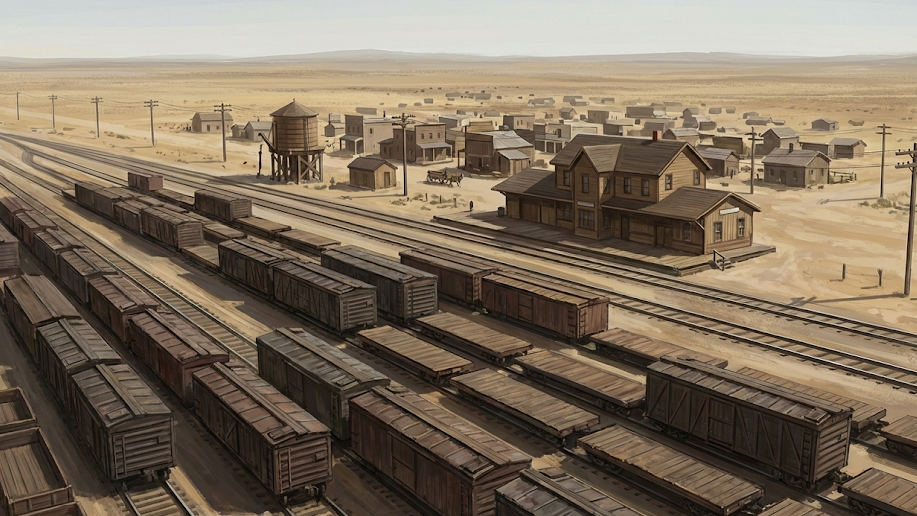
The Railroad As Government
Infrastructure, Not Legend
This period in Las Vegas history is often retold through the lens of vice and personality. That is not the focus here. Between 1905 and 1911, the essential story is structural: who controlled land, who controlled water, and how those controls determined where commerce clustered. The mechanics of infrastructure shaped the map long before entertainment defined the brand.
Company Rule Before City Hall
When the railroad auctioned lots in May 1905, Las Vegas did not yet exist as a city. There was no elected mayor, no city council, no local ordinance book. Authority rested with the railroad and its subsidiary, the Las Vegas Land and Water Company. The same corporation that owned the tracks also owned the water, controlled the townsite grid, dictated deed restrictions, and decided which blocks could host which businesses. Before incorporation in 1911, civic life in Las Vegas operated inside a corporate framework.
Land Use by Deed
The railroad did not simply sell land; it governed how that land could be used. Lot deeds issued by the Las Vegas Land and Water Company contained restrictions governing construction standards, setbacks, and commercial activity. Certain blocks were designated for specific purposes, including the controlled concentration of saloons and gaming establishments. This was not informal influence. It was written into the legal transfer of property. Urban planning in early Las Vegas began not with zoning ordinances but with corporate deed control.
Deed control also reduced uncertainty for outside investors. Buyers at the 1905 auction were not purchasing frontier ambiguity; they were purchasing property inside a managed environment. Building standards protected adjacent parcels from incompatible use. Service guarantees reduced speculation risk. The railroad’s oversight signaled that the town would not dissolve into unregulated sprawl. Predictability was a selling point, and predictability required centralized authority.
The railroad internalized what later cities would externalize through zoning codes and utility departments. Instead of a public planning commission, there was a land company office. Instead of a public utilities board, there was a corporate water system. The functions were recognizable. The ownership was private.
Water as Leverage
Control of the springs meant control of growth. The Las Vegas Land and Water Company guaranteed water service to lot purchasers east of the tracks, but that guarantee did not automatically extend to competing developments. When J.T. McWilliams attempted to promote a rival townsite west of the railroad line, he lacked secure access to the same water infrastructure. Investment followed reliability. Businesses and residents clustered where supply was assured. In early Las Vegas, plumbing determined politics.
Division Point Logic
The same water infrastructure that sustained the town also sustained the railroad’s division point. Steam locomotives required regular replenishment, and division facilities required dependable supply for crews, repair shops, and yard operations. The railroad’s control of water protected both its transportation function and the economic ecosystem that depended on that function. Settlement clustered where railroad operations required permanence.
When the railroad controlled train schedules, it wasn't just moving freight. It was setting the rhythm of daily commercial life in a way that no deed restriction or water guarantee could fully replicate. A merchant's inventory cycle wasn't determined by his own judgment about when to reorder — it was determined by when trains arrived. A contractor couldn't accelerate a building project past the rate at which materials were delivered. Labor demand at the depot spiked and fell on a schedule set elsewhere, in dispatch offices connected by telegraph to a system that extended far beyond Las Vegas. Local economic life was synchronized to an external clock that local actors couldn't adjust. This form of governance is easy to miss because it does not resemble formal authority. There's no ordinance, no deed clause, no water shutoff. There's just a timetable. But the timetable was as coercive as any formal restriction, because deviation from it wasn't really possible. You could, in principle, ignore a deed restriction and face a legal dispute. You couldn't ignore train schedules and remain commercially viable.That clock operated through specific mechanisms. Infrastructure controlled behavior through dependency rather than prohibition. The railroad did not need to issue directives. It set the schedule. The schedule set the tempo of work, delivery, and trade. The railroad was not governing like a landlord. It was governing like a clock.
Train schedules imposed structure beyond the rail yard. Arrival and departure times influenced when goods were unloaded, when merchants restocked, and when passengers entered the town. Telegraph coordination connected Las Vegas to dispatch offices elsewhere on the line, placing local operations inside a wider system timetable. The division point did not operate independently; it functioned as a regulated node inside a larger network. Local work adjusted to that rhythm.
In practical terms, this meant that infrastructure ownership translated into temporal control. The railroad determined when trains stopped, how long they remained, and when they moved on. That authority affected labor demand, inventory turnover, and even street activity near the depot. Governance in early Las Vegas was exercised not only through land deeds and water rights, but through control of movement and time.
A division point was not symbolic. It was mechanical. Locomotives were inspected. Boilers were refilled. Coal was staged. Crews signed off and new crews signed on. Telegraph traffic moved through the depot to coordinate movements north toward Caliente and south toward the Mojave segment. Freight cars were set out, reclassified, or held for scheduled departures. None of that functioned without stable infrastructure. Water was the first requirement. Land control was the second. Corporate authority tied both together.
Administrative Structure Without a City Charter
Between 1905 and 1911, Las Vegas functioned through corporate procedure rather than city statute. The Las Vegas Land and Water Company issued deeds, collected payments, managed water distribution, and enforced restrictions. Railroad supervisors oversaw yard operations, maintenance facilities, and scheduling. Disputes were handled through company channels. If a property owner violated deed terms, enforcement did not require a city ordinance. It required corporate authority. The same hierarchy that moved freight cars also managed the town’s physical layout.
This structure created predictability. Investors understood who made decisions. Businesses knew where service lines would run. Railroad employees knew that employment, housing, and utilities were linked to the same institutional framework. The absence of elected government did not mean the absence of order. It meant that order flowed from infrastructure ownership rather than civic representation.
Employment reinforced that structure. Railroad workers depended on the company not only for wages but for operational continuity. Yard crews, telegraph operators, maintenance personnel, and administrative staff functioned inside a chain of command that extended beyond the town itself. Decisions affecting staffing levels, scheduling, and facility investment were made within the railroad’s broader system, not within a local electorate. The town’s largest employer was also its infrastructure owner and land developer.
This overlap meant that economic leverage and civic leverage were closely aligned. A downturn in rail traffic affected payroll. Changes in operational priorities affected local activity. Corporate governance was not symbolic oversight; it was embedded in the daily rhythm of work, water distribution, and freight movement.
Order and Leverage
Corporate control produced stability, but it also concentrated leverage. Railroad employees drew wages from the same institution that controlled land access and water distribution. Employment, utilities, and economic opportunity were structurally linked. That reduced uncertainty, but it also limited alternatives. A worker dissatisfied with conditions could leave employment, but departure often meant leaving the town’s primary economic system.
The same applied to competing development. J.T. McWilliams possessed capital, engineering credentials, and a surveyed plat. What he lacked was infrastructure control. The railroad’s ownership of the springs and its division point authority determined which townsite received reliable service. The system functioned efficiently. It did not function neutrally.
A Competing Town Without Infrastructure Control
J.T. McWilliams was not an amateur speculator. He was a trained civil engineer and experienced surveyor who had designed city water systems in Arizona and California. In 1904, before the railroad’s formal auction, he purchased eighty acres from Helen Stewart west of the tracks and subdivided the land as the “McWilliams Original Townsite of Las Vegas.” Lots were advertised in Los Angeles for as much as $200 each. Initial sales were strong.
What McWilliams did not control was the division point or the springs. The railroad’s subsidiary guaranteed water service and rail adjacency inside its own platted townsite. McWilliams’ development depended on negotiations with the same corporation that was simultaneously promoting a competing town. Infrastructure alignment favored the Clark townsite. Commercial clustering followed infrastructure certainty.
Economic Gravity of the Depot
The depot functioned as the physical center of authority. Passenger arrivals, freight handling, telegraph dispatching, and crew changes all converged at that location. Businesses that depended on traffic positioned themselves accordingly. Hotels, restaurants, supply houses, and freight agents located near the tracks because proximity reduced transfer time and uncertainty. The railroad did not need to mandate clustering by ordinance. Operational gravity accomplished the same result.
In practical terms, distance from the depot meant distance from reliable movement. A merchant located within walking range of freight unloading could restock efficiently. A merchant outside that radius faced delay and additional handling. The map of early Las Vegas reflected logistics logic before it reflected civic design. The town’s commercial spine aligned with rail operations.
Freight Defined the Early Economy
Between 1905 and 1911, Las Vegas existed because trains required a servicing interval. That need generated secondary work. Carload freight moving between Southern California and the Intermountain West passed through the division point. Supplies for mining districts, ranching operations, and regional settlements were staged, transferred, or temporarily stored. Local merchants did not operate in isolation; they operated inside a through-corridor.
The town’s early economy depended less on local production and more on movement. Wages were tied to railroad employment. Commercial viability depended on access to inbound freight and outbound distribution. Even retail activity was indirectly supported by rail throughput. Las Vegas was not yet a destination. It was an interval in a transportation system.
Freight moving through the division point during these years was not abstract tonnage. It consisted of coal for locomotives, lumber for construction, machinery for mining camps, agricultural supplies for surrounding ranch operations, and consumer goods bound for emerging settlements across Southern Nevada and eastern California. Outbound shipments included ore concentrates, livestock, and agricultural products. The division point did not merely service trains; it integrated the region into a larger exchange network anchored in Los Angeles and Salt Lake City.
This pattern reinforced the railroad’s governing position. The company controlled the timetable, the sidings, the yard space, and the allocation of service. A merchant’s ability to receive goods efficiently depended on alignment with railroad operations. A contractor’s ability to build depended on material delivery schedules. Economic tempo followed train schedules. Time itself was regulated by rail infrastructure.
From Corporate Interval to Municipal Entity
By 1911, the town had reached a scale that required formal civic structure. Incorporation did not create Las Vegas; it formalized a settlement already organized by infrastructure ownership. Streets had been platted. Water lines had been laid. Commercial districts had clustered around the depot. Administrative authority had functioned through corporate hierarchy for six years.
Incorporation shifted governance from private corporate management to public city authority, but it did not erase the underlying geography. The rail alignment, the depot-centered commercial core, and the water-dependent growth pattern remained intact. The framework built between 1905 and 1911 established the corridor logic that would shape freight movement, land use patterns, and infrastructure decisions long after the railroad ceased to function as the town’s governing authority.
Sources
-
Background on the railroad’s construction, division point operations, and corporate structure.
-
Details on the 1905 auction, deed restrictions, and formation of the Las Vegas Land and Water Company.
-
UNLV Special Collections and Archives, Union Pacific Railroad Collection.
Corporate records documenting early townsite administration and rail operations in Las Vegas.
-
K. J. Evans, “J. T. McWilliams,” Las Vegas Review-Journal, February 10, 1999.
Background on the McWilliams townsite and infrastructure competition west of the tracks.
Leave a Comment
Comments are reviewed before they appear publicly.