Highway Series Part 7: Industry Follows the Corridor
A System Put to Work
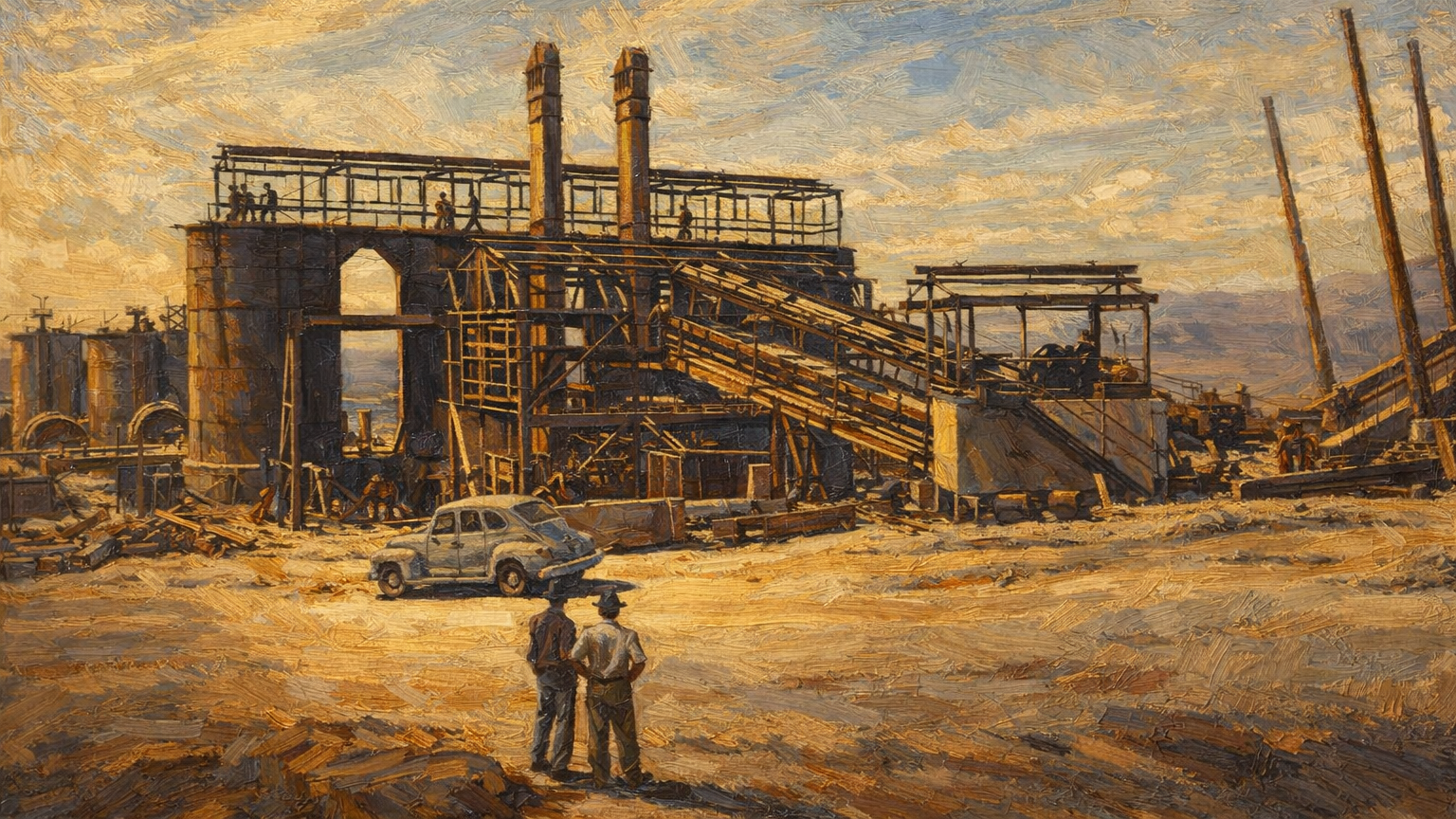
In 1941 and 1942, the federal government built the Basic Magnesium Plant southeast of Las Vegas. The location was chosen because it combined access to the established corridor with a large, reliable supply of electrical power from Hoover Dam. That corridor had already carried millions of tons of material into Black Canyon and could now carry raw inputs into a plant and move finished material out at scale. At this stage, there was no town—only a single-purpose industrial project.
Magnesium production required continuous input and output. Raw materials moved on a fixed schedule to match the operating rate of the plant.
Equipment, chemicals, and bulk materials entered the site by rail and truck in steady volume, with spur connections extended from the Boulder City branch line. Supporting materials arrived by truck from the surrounding region.
The plant depended on that flow. If shipments slowed, production slowed.
Finished magnesium moved out on the same schedule. Output did not wait for demand to build. It left the plant as it was produced. Railcars and trucks carried material to other industrial centers where it entered aircraft production.
The corridor handled both directions at the same time. Inputs arrived on schedule. Output departed on schedule.
Freight fed a fixed production system. The destination was a plant that depended on continuous supply and continuous removal of output.
Some freight moved directly from the plant to U.S. Route 91 without passing through Las Vegas. This created a second layer of movement, where industrial freight could bypass the city and connect directly to the main corridor.
From Project to Permanent Node
Henderson was created as an industrial site to use the power and the corridor made available by Hoover Dam. The system built to construct the dam now supported production. The city was named after Senator Charles Belknap Henderson. The location existed because the system supported production.
Between 1942 and 1945, the Basic Magnesium Plant became one of the largest magnesium facilities in the world. Thousands of workers arrived. Housing was built around the plant. Roads connected the site to the corridor. Utilities were extended to sustain operation. The area began to function as a settlement because the system required a workforce on schedule.
Between 1945 and 1947, the war ended and plant operations collapsed. Production stopped, but the infrastructure remained. Power, water, roads, and rail access were still in place. The site remained connected to the corridor. The site could support new production without changing location.
Between 1947 and 1953, facilities were sold and repurposed and private industry moved in. The location still had power, water, and direct access to the corridor. New production used the same inbound supply and outbound routes. Freight continued to move through the site on schedule. Existing facilities allowed new operators to begin production without rebuilding the system.
In 1953, Henderson was officially incorporated as a city. That action formalized an existing industrial node. Production, workforce, and freight movement were already established. Incorporation recognized it.
Chemical processing, materials production, and other industrial operations moved into the site. Each required steady input and steady output. Each depended on the same power, water, and transportation links. Bulk materials moved in by rail. Finished products moved out by truck along the highway corridor. These operations included chemical processing and materials handling tied directly to inbound rail shipments and outbound truck distribution.
Industrial operations at the site continued under new ownership and new purposes. Facilities were adapted rather than abandoned. Production shifted from wartime output to peacetime industry. The buildings, utilities, and connections to the corridor remained in use. The site operated as a fixed industrial location within the corridor. Different operators used the same infrastructure to move different materials. Freight continued to arrive, production continued to operate, and output continued to move out on schedule.
Hoover Dam fixed large-scale electrical power in place. The Basic Magnesium Plant was built in the Las Vegas Valley because it required that power. That constraint tied production to the corridor and fixed the location.
The plant required more than power. It required housing, roads, water systems, and utilities to support a large workforce operating on a continuous schedule. The federal government built that infrastructure to sustain production. That infrastructure became Henderson.
After the war, the physical system remained in place. Power, water, access, and housing were already established. Private industry moved into that system and resumed production with different inputs and outputs. The location did not change because the system did not change.
Henderson formed where power, movement, and production aligned. Production operated continuously. Output moved out on the same corridor. The city remained because the system functioned.
The crossing made the difference. After the crossing, it moved on schedule. Once that reliability was proven, production could anchor to it. The corridor could carry continuous industrial load, not just pass-through traffic.
Henderson became part of a larger pattern of industrial movement. Freight moved between fixed production sites connected by the same highway and rail system. The corridor now supported multiple origins and destinations within the region. That shift marked the transition from a single corridor to a developing network. These sites operated within a shared system of movement across the valley.
The network spread into the Las Vegas Valley through connecting roads, industrial streets, and local distribution routes. The next stage formed inside the city itself.
Sources
The following sources support the historical and operational claims made in this article.
-
Our History . City of Henderson. URL
Supports the city’s wartime origins in the Basic Magnesium Plant, the scale of the workforce, the Basic Townsite housing buildout, the naming of Henderson, the 1947 crisis after magnesium production collapsed, and official incorporation in 1953.
-
Boulder City and Henderson, Nevada . National Park Service. URL
Supports the link between Hoover Dam and wartime industry by documenting the cheap hydroelectric power, water supply, federal financing, magnesium production role, and peak employment that made the Henderson plant possible.
-
A Timeline of Clark County History . Clark County, Nevada. URL
Supports key dates used in the post, including the 1941 contract to build the Basic Magnesium plant, the 1944 Henderson post office date, and the city’s incorporation on April 16, 1953.
-
Basic Magnesium, Inc. (BMI) Records and Photographs . UNLV Special Collections and Archives. URL
Archival collection documenting the planning, construction, management, and physical development of the BMI plant. Useful for claims about the site as a large industrial project supported by built infrastructure rather than an isolated factory.
-
Basic Magnesium, Inc. . UNLV Special Collections and Archives. URL
Supports the transportation side of the post. The collection description notes that BMI constructed a railroad for the transportation of raw materials and helps support the article’s description of rail-linked industrial logistics at the site.
-
Southern Nevada Historical Society Photograph Collection on Basic Magnesium, Inc. . UNLV Special Collections and Archives. URL
Photograph collection documenting construction of the BMI site and related infrastructure. Useful for visual evidence of the plant’s scale, temporary camps, utility works, and the rail-connected industrial landscape southeast of Las Vegas.
Leave a Comment
Comments are reviewed before they appear publicly.