Highway Series Part 3: When Trucks Replaced the Wagon
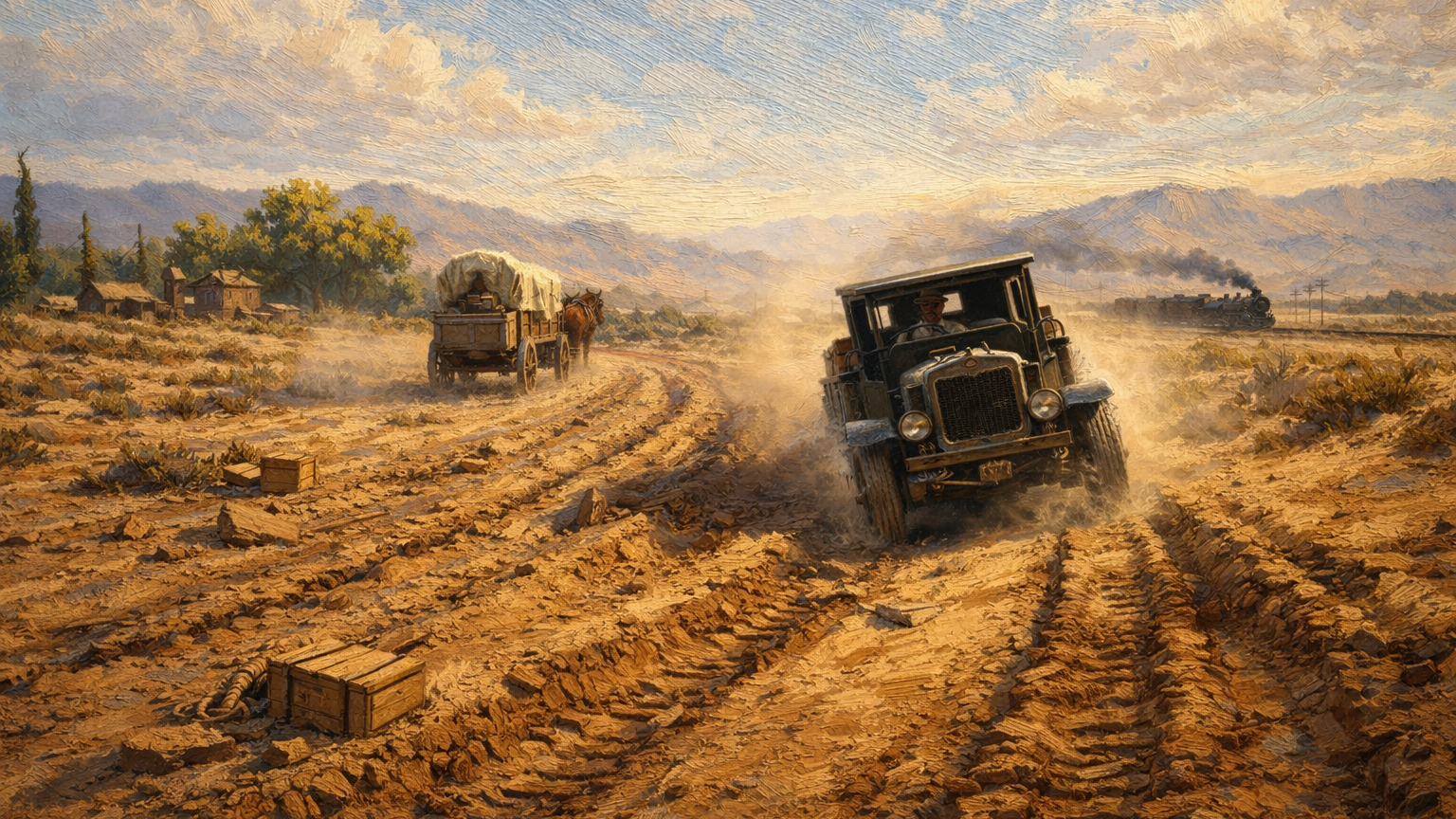
A New Machine on an Old Road
By the late nineteenth century the desert road through the Las Vegas Valley was already a working freight corridor. Wagon trains carried supplies north toward mining districts and hauled ore south toward rail connections. The route took decades to establish. Mule caravans wore the first faint trails into the desert floor, and wagon wheels widened them into a recognizable road. Generations of travelers proved the corridor worked.
At the beginning of the twentieth century a new machine began appearing along those same desert roads: the motor truck.
The first trucks to enter the Mojave were crude by later standards. Their engines were small and unreliable, and their solid rubber tires were poorly suited to the rough surfaces of unpaved desert roads. Drivers carried tools, spare parts, and extra fuel as a matter of course. The desert offered little help if something went wrong between stops.
Early motor trucks were not obviously better than the wagon teams they were beginning to replace. A loaded freight wagon pulled by a healthy team of horses could cover the same ground at roughly the same pace. Horse teams knew the road, responded to familiar terrain, and could be trusted to hold a grade. The truck driver had no such partnership with his machine.
Yet the motor truck offered something that animal power could not.
That shift would transform not just how freight moved across the Mojave, but how the desert roads themselves were built and maintained.
Railroads Solved One Problem but Left Another
Railroads transformed freight movement across the American West. A single train could haul more cargo than dozens of wagon teams combined, and rail lines reduced travel time between distant cities from weeks to days. By the time tracks reached southern Nevada at the turn of the twentieth century, the railroad had already reshaped commerce across the region.
But the railroad solved only part of the freight problem.
Trains ran on fixed tracks between fixed depots. A shipment arriving at a rail yard in Las Vegas had completed only part of the journey. The railroad delivered cargo to the station, but everything beyond it required a different kind of transportation.
Freight bound for a mining camp twenty miles into the hills could not reach its destination by rail. No tracks lead to the camp. Supplies destined for a ranch north of the valley, a military post in the interior, or a construction site out in the desert faced the same limitation. The train carried goods as far as the rails extended, and beyond that point the load transferred to wagons.
For decades that final leg of every journey belonged to teamsters. They hitched horse or mule teams to loaded wagons and hauled freight along the same desert roads the railroad had not replaced. Mining districts received timber, powder, and machinery only because those drivers moved it from the railhead into the interior.
The railroad and the wagon road worked together. Neither system alone was sufficient.
This arrangement functioned, but it was slow and expensive. Every transfer between rail car and wagon added cost. Cargo had to be unloaded, sorted, and reloaded, and teams had to be harnessed and driven. The last miles of any shipment were often the hardest and most expensive miles of the route.
The motor truck offered a way to change that equation.
The First Motor Trucks Appear
The first freight trucks to operate across the Mojave Desert were crude machines by any measure.
Their engines were small and underpowered, built more for short hauls near towns than for long desert crossings. Cargo capacity was limited. A loaded wagon pulled by a good mule team could often carry as much freight as the early trucks, and sometimes more. The trucks rode on solid rubber tires that transmitted every rock and rut directly through the frame. On rough desert roads those tires failed regularly, and a split tire far from the nearest town meant hours of delay and hard work in the open heat.
Mechanical breakdowns were common. Engines overheated on long grades, and cooling systems were primitive and not designed for sustained operation in extreme temperatures. Drivers carried tools and spare parts as standard equipment, much as wagon drivers once carried extra harness leather and wheel pins. The desert offered no roadside assistance. If a truck stopped running between water stops, the driver fixed it himself or waited for help that might take hours to arrive.
Many experienced teamsters watched these machines with skepticism.
“They’ll never replace the mule” proved to be a false prophecy.
The desert, they understood, punished unreliable equipment without mercy. Early motor trucks did not enter a modern transportation system. They entered the same one wagon drivers had used for decades.
Teamsters who had spent their working lives with mule teams understood animals in a way they did not understand engines. A good mule knew the road. It responded to weight shifts on a grade, kept its footing on loose ground, and could be trusted to stop at water. The truck offered none of that partnership. It failed without warning and gave the driver little to work with when it did.
Some teamsters accepted that trucks might be useful for short runs near towns and rail depots, where a breakdown was an inconvenience rather than a crisis. But few believed trucks would replace animal teams on long desert hauls between settlements.
Dirt Roads and Desert Conditions
Across most of the American West, roads in the early twentieth century were still dirt tracks worn into the landscape by repeated travel. Where terrain allowed, wagon paths ran fairly straight between water stops and settlements. Where it did not, the road curved around rocky outcrops, skirted soft ground, and threaded through mountain passes along the line of least resistance. No engineer had designed these routes. Repeated use made them visible.
Southern Nevada was no exception. The corridor through the Las Vegas Valley, used for generations, remained the main overland route through the region. It had never been graded, drained, or surfaced for anything heavier than a loaded freight wagon. When the first motor trucks began using it, the road did not change to accommodate them.
Truck drivers faced the same conditions wagon drivers had always faced.
Deep sand collected in low ground and along valley floors where wind deposited it season after season. A loaded wagon could push through with enough pulling at the front. A loaded truck could dig itself in and stop. Storms washed out sections of road that had been passable the week before. At familiar crossings, drivers sometimes found the road had shifted or disappeared beneath debris left by a flash flood. Long stretches of desert still separated reliable water sources. A truck did not drink, but its engine required water for cooling just as surely as any mule team.
Yet trucks carried advantages many teamsters had not seen.
Why Trucks Eventually Won
The teamsters who dismissed early motor trucks were not wrong about their weaknesses. The machines broke down often, struggled on soft ground, and demanded constant mechanical attention. The criticisms were accurate.
But the critics measured the truck against an ideal that wagon teams did not always meet.
A mule team had its own limits, and freight operators knew them well. Animals had to be fed every day whether they worked or not. They needed water at regular intervals, which on a desert route meant planning every leg around dependable springs and troughs. After a hard day of hauling, a team needed rest before it could work again. In the summer heat, teams could not be pushed without risking injury or death. A freighter who owned twenty mules owned twenty animals that required daily care and carried daily cost, whether freight moved or not.
A truck sat idle for free.
When freight needed to move, the engine started and the truck went to work. When it did not, no feed bill accumulated. One driver replaced a full team operation. For businesses that depended on frequent, flexible deliveries, that arithmetic mattered.
Trucks could make more trips in a single day than a wagon team could manage. On routes connecting rail depots with nearby towns, ranches, and work sites, a truck could complete several runs while a horse team completed one. Freight that arrived by rail in the morning could reach its destination by afternoon. The same delivery by wagon might not arrive until the next day.
Operators who adopted trucks found that flexibility offset the breakdowns.
One by one, freight businesses across the desert Southwest began replacing their wagons. Not all at once, and not without resistance. But the direction of the change was clear.
From Teamsters to Truck Drivers
For many years after motor trucks first appeared on the desert roads of southern Nevada, wagons and trucks shared the same corridors. Freight moved by both methods at once. Trucks handled the routes they could manage. Wagons carried loads into terrain the trucks could not yet reach.
Rough terrain still favored animal teams. In narrow canyons, across steep grades, and along loose desert tracks, a mule team could go where early trucks could not. Animals that had worked a route for years knew its character in a way no engine could replicate. A seasoned team handled soft ground, steep grades, and narrow passages without instruction. Operators moving freight into difficult country kept their animals working long after trucks took over easier routes.
But engines improved steadily. Each new generation carried more weight, ran more reliably, and handled rough surfaces better than the last. As failures became less frequent, the case for keeping wagon teams weakened.
Roads also changed, slowly. As truck traffic increased along the main desert corridors, the wear it caused forced attention to the road surface. Ruts left by iron wagon wheels gave way to a different pattern of damage. Local governments and freight operators filled low spots and graded the worst sections. The improvements were modest, but they made the roads more passable for motor vehicles.
Wagon trains did not disappear at once. They thinned season by season until a large freight wagon on the main desert road became an unusual sight.
Roads Begin to Change
Wagon traffic had worn the desert roads into existence through repetition. Trucks began to wear them out.
Iron wagon wheels pressed into the desert surface and left ruts, but they did not tear it apart. Motor trucks were heavier, and their engines drove the wheels with a force animal teams could not match. After a storm, loaded trucks could tear through soft ground, leaving holes and washouts that made the route difficult for the next vehicle. Roads that had held up for decades began to fail.
The problem was impossible to ignore. Freight that could not move by road cost money. Local governments that depended on commerce between towns had reason to keep routes passable. As truck traffic increased along the main corridors of southern Nevada, their condition became a recurring concern for operators, merchants, and officials.
The early responses were modest. Road crews filled the worst ruts and leveled damaged sections. Low areas that flooded after storms received basic drainage work. Bridges appeared across wider desert washes where wagons had once forded and trucks sometimes could not cross. Painted markers and simple signs appeared at key intersections where routes had once been learned by memory.
None of this amounted to a highway system. The improvements were scattered, inconsistent, and often temporary. A road graded smooth in the spring might be badly rutted again by autumn.
But expectations had changed.
Wagon roads had simply existed, shaped by use and maintained by no one in particular. Truck traffic demanded deliberate attention. Over time, that attention produced something new: a formal highway network across the American desert.
Las Vegas in the Truck Era
The geography that made Las Vegas a critical stop did not change when motor trucks appeared.
The valley sat at the intersection of routes moving north toward Utah, south toward California, and west into the mining districts of central Nevada. The springs that once drew mule caravans and wagon trains were no longer the main reason to stop, but the routes they established remained the most practical paths through the terrain. Mountain ranges defined passage. Valley floors offered the most direct lines across the desert. Truck drivers followed the same corridors because the landscape left little reason to do otherwise.
Freight moving between California and the interior West still passed through the Las Vegas Valley.
Rail connections made the valley a distribution point for goods arriving from distant markets. Supplies bound for mining operations to the north and west arrived by train, then transferred to wagons or trucks for the final haul into the interior. Goods produced or processed in the region moved the other direction, toward the railhead and out to broader markets. That pattern, established during the wagon era, continued as trucks took over more of the local and regional freight work.
The valley’s position meant that improvements to the desert road through southern Nevada mattered beyond the valley itself. A better route through Las Vegas was a better route between California and Utah. Freight operators, merchants, and eventually state and federal officials all had reason to pay attention to the condition of the corridor through the valley.
The same geography that shaped the wagon road would shape the truck route. The truck route, improved and formalized over the coming decades, would become the highway.
The Road Becomes a Highway
By the early twentieth century the desert corridor through the Las Vegas Valley carried a different kind of traffic than it had a generation earlier.
Motor trucks had begun replacing wagons on the freight routes connecting California, Utah, and the mining districts of the interior West. The transition was incomplete. Wagons had not disappeared, and the roads remained rough, unpaved, and poorly maintained by any modern standard. The direction of change was clear. More trucks appeared on the desert roads each year. More freight moved by engine rather than animal team. The roads that carried that traffic proved inadequate for the work being asked of them.
The pressure for better roads did not come only from freight operators. Automobiles also began appearing on the same desert corridors, carrying travelers rather than cargo. Drivers encountered the same ruts, washouts, and sandy stretches that frustrated truck operators. Their complaints added to a growing chorus calling for improved roads across the American West.
State governments began responding. Federal officials paid attention. Organizations of motorists and business owners pushed for coordinated road improvement across state lines. Out of that pressure came the first formal highway systems, networks of numbered and maintained routes connecting cities and regions across the country.
When engineers and planners identified which desert corridors deserved investment and formal designation, they looked to routes that freight and travel had already proven workable. The corridor through the Las Vegas Valley had carried traffic for decades. Its path through the terrain was well understood. Its importance as a connection between California and the interior West was established.
The old wagon road across the Mojave was about to receive a new name, a graded surface, and eventually a number on a roadside sign.
The highway era was beginning.
Sources
The following sources support the historical and operational claims made in this article.
-
Las Vegas History Timeline . City of Las Vegas. URL
Documents the founding of Las Vegas as a railroad town in 1905 and explains the role of the springs, rail stop, and early infrastructure in establishing the corridor.
-
Old Spanish National Historic Trail . National Park Service. URL
Establishes the early trade corridor across the Mojave and explains how repeated travel by mule caravans formed the routes later used by wagons, trucks, and highways.
-
Highway History . Federal Highway Administration. URL
Provides background on early road conditions, the lack of formal highway systems, and the gradual development of organized, numbered road networks in the early twentieth century.
-
Motor Carrier Act of 1935 and Early Trucking Regulation . Federal Motor Carrier Safety Administration (FMCSA). URL
Explains the emergence of trucking as a regulated freight system and provides context for the transition from informal freight movement to structured carrier operations.
-
Truck (Vehicle) . Encyclopaedia Britannica. URL
Describes early motor truck development, limitations of early designs, and the gradual improvement in reliability and capacity that allowed trucks to replace animal-powered freight.
Leave a Comment
Comments are reviewed before they appear publicly.